
Where is the VIN in the Honda Accord?
Select your car's generation to see the exact VIN number locations
VIN Location Overview for Honda Accord
3 generationsSelect the generation of your car to see the exact VIN number locations
| Generation & Years | Typical VIN Locations | Details | |
|---|---|---|---|
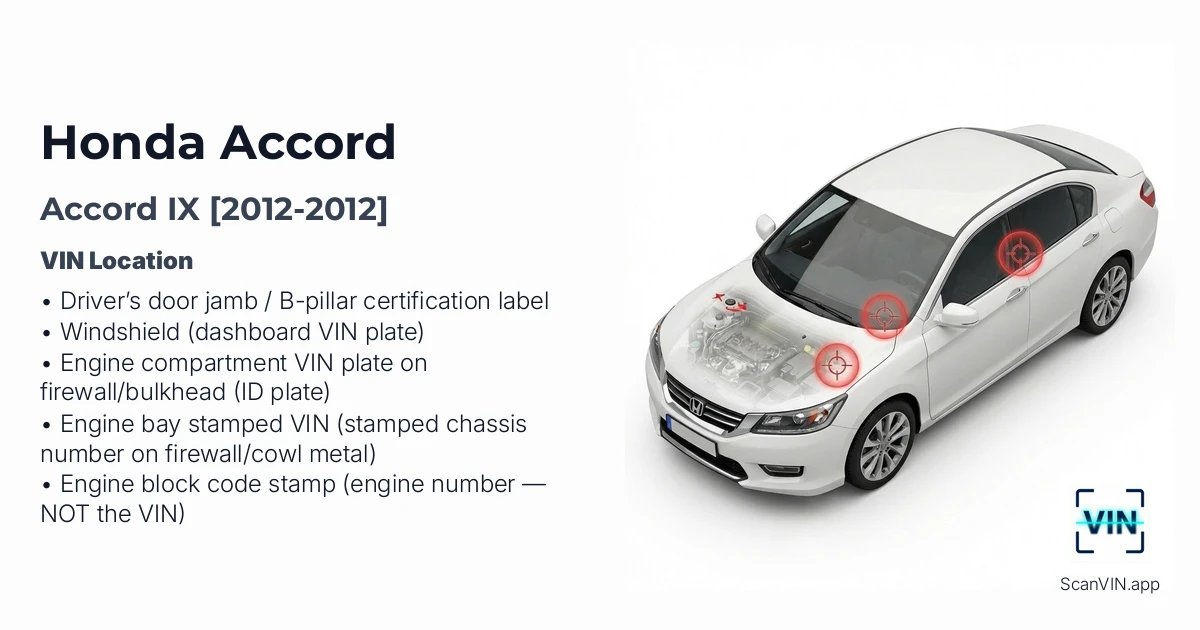 | IX 2012 2012 | Driver’s door jamb / B-pillar certification label Windshield (dashboard VIN plate) Engine compartment VIN plate on firewall/bulkhead (ID plate)
+2 | View details |
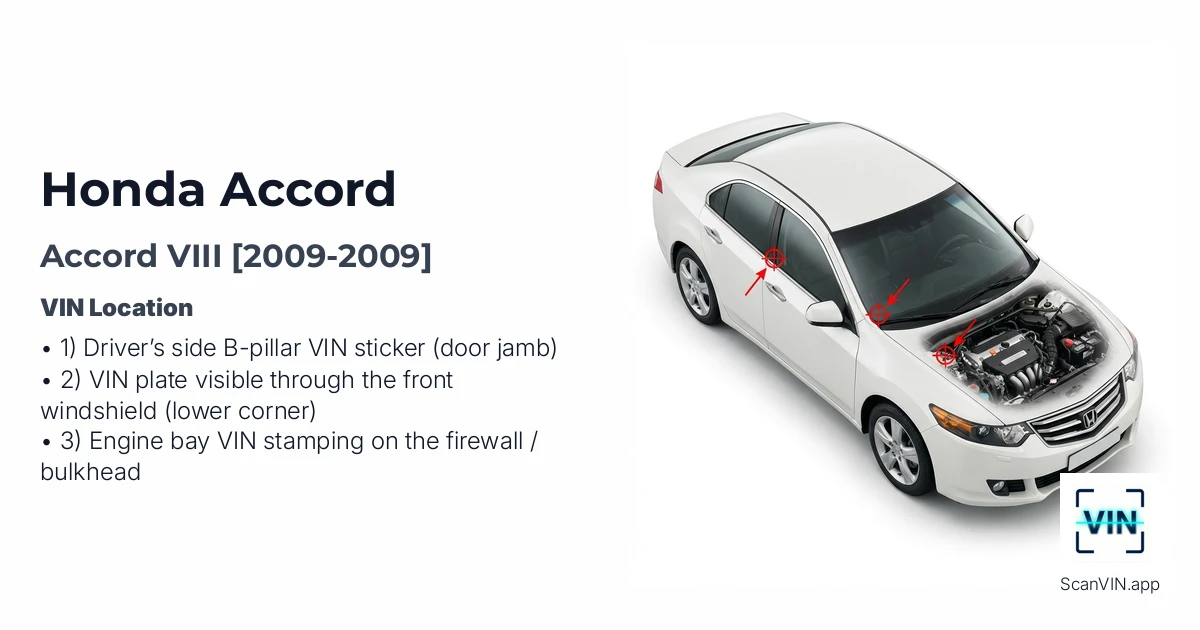 | VIII 2009 2009 | 1) Driver’s side B-pillar VIN sticker (door jamb) 2) VIN plate visible through the front windshield (lower corner) 3) Engine bay VIN stamping on the firewall / bulkhead | View details |
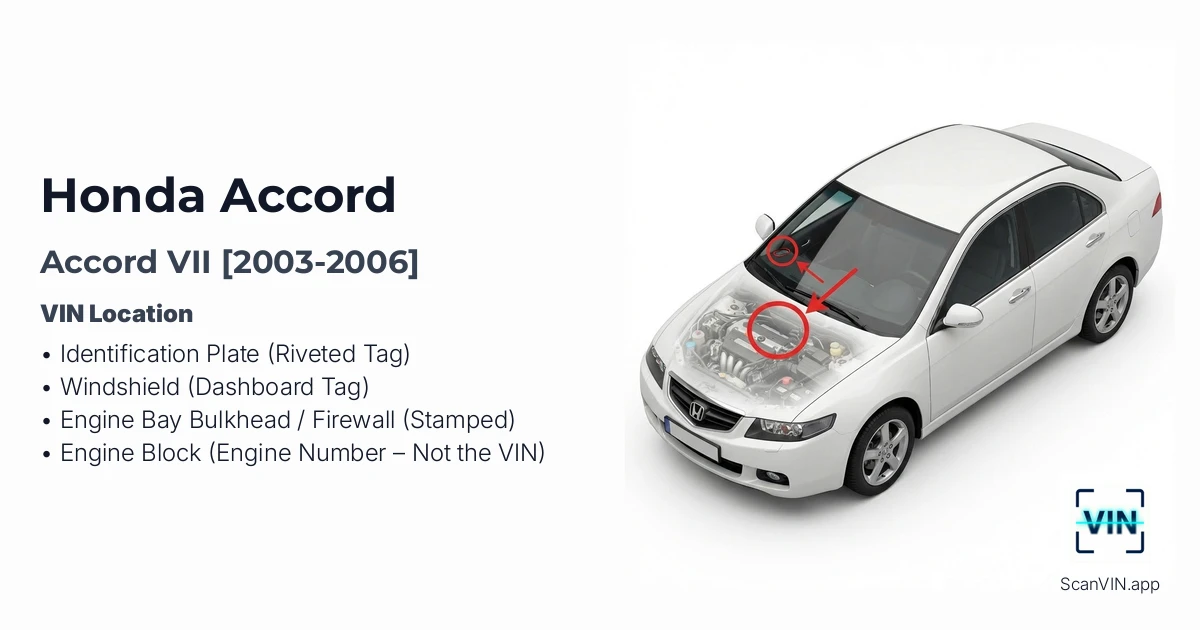 | VII 2003 2006 | Identification Plate (Riveted Tag) Windshield (Dashboard Tag) Engine Bay Bulkhead / Firewall (Stamped)
+1 | View details |
IX 2012 2012
VIII 2009 2009
VII 2003 2006
Honda Accord Honda Accord IX [2012-2012]
Quick response
Quick Answer: The most reliable VIN location for the Honda Accord is the certification label on the driver’s side B-pillar (door jamb). It’s typically located on the pillar area you see when you open the driver’s door. Expert tip: this is the easiest, cleanest spot to read—no crawling into the engine bay required.
This guide covers the VIN (17-character chassis number) locations for the Honda Accord IX [2012-2012].
Chassis Number Locations
Driver’s door jamb / B-pillar certification label 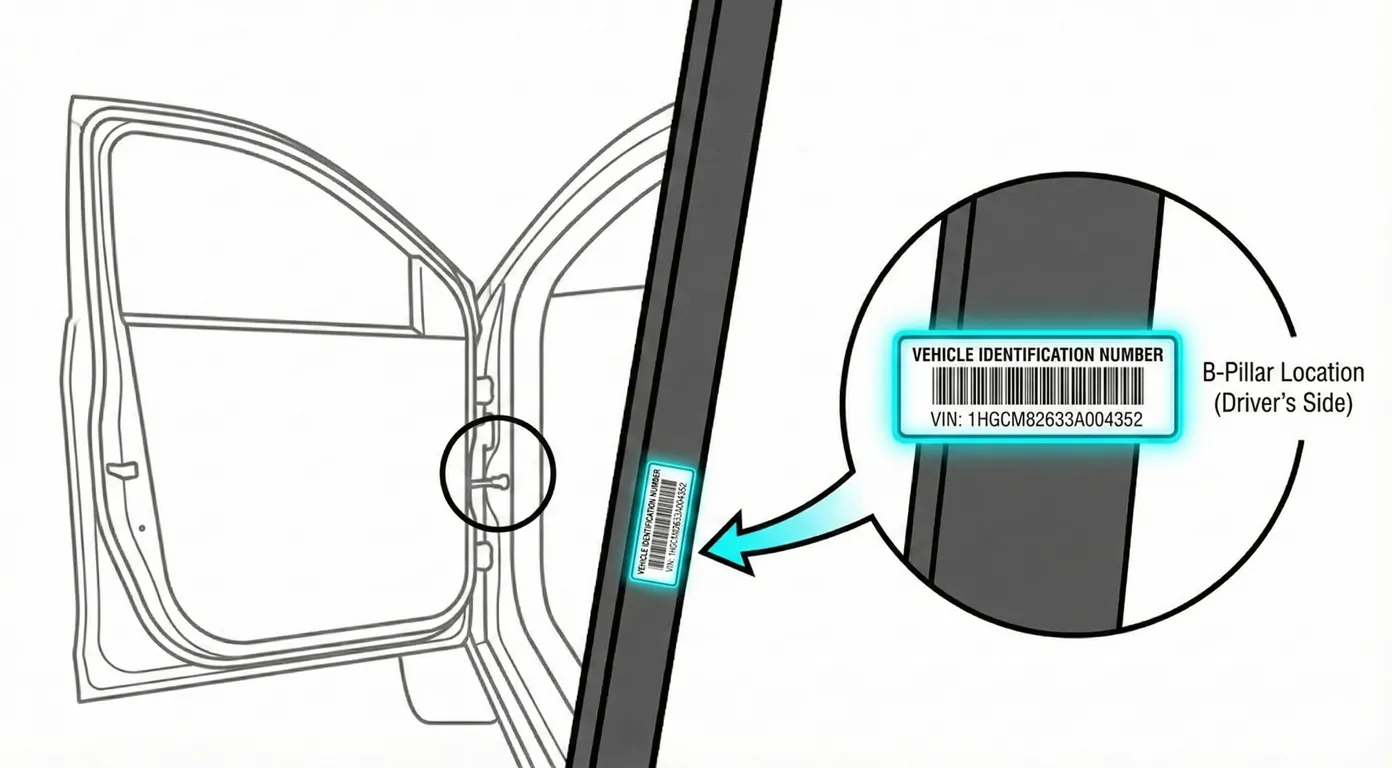
- Where to look: Open the driver’s door and inspect the B-pillar area for the certification label/sticker showing the VIN, tire pressures, and build information.
- Access: Very easy—standing access, no tools needed.
- Note: This location is common on LHD (US/EU) cars and is usually the fastest way to confirm the VIN matches the paperwork.
- Tip: Stickers are quick to read but easy to mistype—scan it directly with your phone so you don’t transpose characters like 8/B or 0/O.
Windshield (dashboard VIN plate) 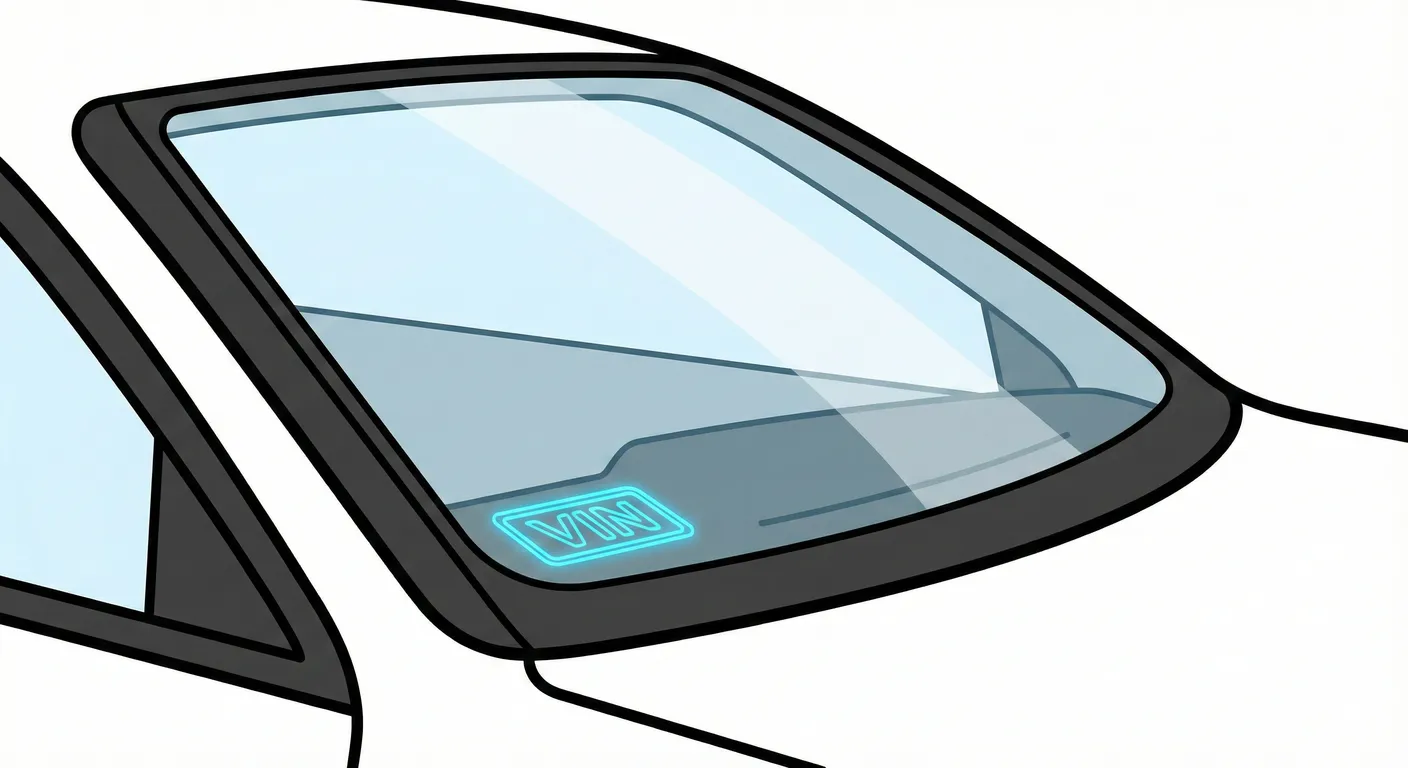
- Where to look: From outside the car, look through the lower corner of the windshield on the driver’s side at the VIN plate on top of the dashboard.
- Access: Easy, but you’re reading through glass.
- Note: Standard VIN position for many US/EU-market vehicles.
- Tip: Glare and reflections can wash out the digits—capture it instantly with the VIN scanner so you don’t have to squint or guess the last characters.
Engine compartment VIN plate on firewall/bulkhead (ID plate) 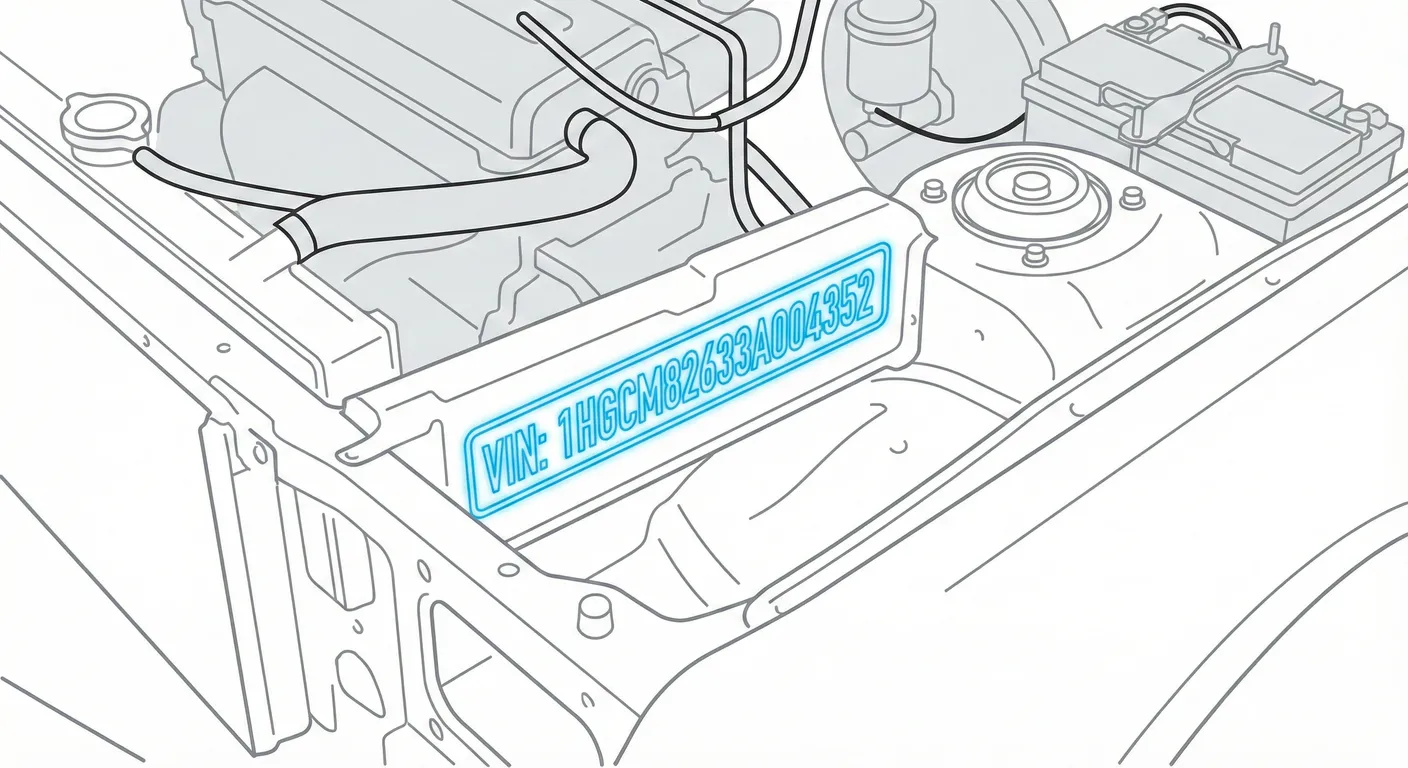
- Where to look: Open the hood and look at the firewall/bulkhead, deep behind the engine, around the center area under the wiper cowl line. The report vehicle shows a metal plate riveted vertically on the firewall, partially blocked by heater hoses/wiring.
- Access: Moderate—this plate sits recessed; you may need to reposition hoses slightly by hand (don’t disconnect anything) and use strong lighting.
- Note: Placement can vary by market and LHD/RHD configuration; on some RHD cars it appears more toward the passenger side (in RHD context). For LHD owners, use the firewall “deep behind engine” description rather than copying left/right from RHD videos.
- Tip: It’s dark and awkward to read at arm’s length—use the ScanVin.app VIN reader to scan the plate without writing it down in a cramped position.
Engine bay stamped VIN (stamped chassis number on firewall/cowl metal)
- Where to look: In the engine bay, locate the VIN stamped directly into the firewall/bulkhead metal near the cowl/firewall structure. It’s a body-metal stamping (not a sticker), so you’re looking for indented characters.
- Access: Low to moderate—usually visible once you know where to look, but dirt and low contrast can hide the stamp.
- Note: This stamped location is more commonly highlighted on EU/Asian-market cars; exact placement can shift between LHD vs RHD layouts.
- Tip: If the stamp is dusty or low-contrast, wipe it and then scan using high-contrast VIN capture to pull the characters out cleanly.
Engine block code stamp (engine number — NOT the VIN)
- Where to look: On the front of the engine block, near the transmission bell housing junction, there’s a machined flat pad stamped with an engine code (example: K24W1) and serial.
- Access: Hard—deep in the bay, vertical surface, often oily/dirty.
- Note: This is not the 17-digit vehicle VIN. It’s useful to verify the engine, but don’t use it as the chassis VIN for registration/history checks.
- Tip: If you’re verifying engine identity, grime is the main enemy—clean the pad and use ScanVin.app’s high-contrast scan to read faint stamps without guesswork.
Video Guide
Video Tutorial: 2013 2014 2015 Honda Accord Engine Code Stamp Location
- Clear narrated walkthrough showing the engine code/engine number stamp location on a US-spec 9th gen Accord (this is engine identification, not the 17-digit VIN).
Common Problems & Troubleshooting
- Firewall plates/stamps are hard to read because they sit deep under the cowl and get shadowed by hoses and wiring—use a flashlight and wipe the surface before trying to read it.
- Stamped VIN contrast is often low (dirt + body-color paint), so scrub lightly with a rag and take the photo straight-on to avoid “missing” characters.
- Door-jamb VIN stickers can be missing or replaced after bodywork—if the sticker looks new, damaged, or tampered with, cross-check against the windshield VIN and the engine-bay stamp/plate.
Frequently Asked Questions
Where is the VIN on Honda Accord?
Check the driver’s side B-pillar/door jamb certification label first. A second easy spot is the VIN plate visible through the lower driver-side windshield corner.
Which VIN location is the most important for Honda Accord?
Use the body/chassis VIN (17 characters) from the door-jamb label or windshield plate for paperwork and history checks, then confirm it matches the stamped VIN/ID plate in the engine bay if available.
Honda Accord Accord VIII [2009-2009]
Quick response
Quick Answer: The most reliable VIN location for the Honda Accord VIII is the driver’s side B-pillar (door jamb) VIN sticker. It’s typically located on the lower section of the B-pillar when you open the driver’s door. Expert tip: it’s high-contrast and flat—one of the easiest places to scan cleanly.
This guide shows the VIN (chassis number) locations for the Honda Accord VIII (2009-2009), including the fastest places to check and the harder, hidden stampings you may need for verification.
Chassis Number Locations
1) Driver’s side B-pillar VIN sticker (door jamb)
- Where to look: Open the driver’s door and look at the lower section of the B-pillar (the center pillar between the front and rear doors). You’ll see a black label/sticker with light-colored text.
- Access: Low difficulty. No tools needed—just open the door and wipe dust off the label if needed.
- Note: This is shown on an LHD car; on RHD market cars, the equivalent label is often on the other side.
- Tip: For fast, error-free capture (and to avoid misreading similar characters like 8/B or 0/O), scan it directly with your phone on the flat sticker surface.
2) VIN plate visible through the front windshield (lower corner)
- Where to look: From outside the car, look through the windshield at the bottom corner on the left side (LHD driver’s side). The VIN is on a tag/plate fixed to the top of the dashboard.
- Access: Medium difficulty. The VIN is easy to find, but glare/reflections on the glass can block the characters.
- Note: On RHD cars, this plate may be on the opposite lower corner.
- Tip: If glare is washing it out, change your angle and capture it instantly with the VIN scanner so you don’t have to squint and manually type it.
3) Engine bay VIN stamping on the firewall / bulkhead
- Where to look: Open the hood and locate the firewall (bulkhead) behind the engine. The VIN is stamped into the metal, and in the referenced view it sits partly under/behind the black plastic cowl/scuttle trim—you may need to lift the rubber weather strip to see it.
- Access: High difficulty. It’s recessed, dark, and shadowed, and the stamped characters can be the same color as the body paint (low contrast).
- Note: This is a true “chassis stamping” style location used for verification.
- Tip: Use a flashlight and a steady angle—then use the ScanVin.app camera scan so you don’t have to copy the stamp while leaning over the engine bay.
Video Guide
Video Tutorial: Where is the VIN number of my Honda Accord VIII ( 2007 – 2016 ) | All Possible VIN Number Locations
- A clear walkthrough showing the firewall stamping, windshield VIN tag, and the driver-side B-pillar sticker on a LHD Accord.
Common Problems & Troubleshooting
- Windshield VIN is hard to read: Sunlight and sky reflections can hide the text—shade the area with your hand and change your viewing angle.
- Firewall stamping looks “blank”: It’s often painted over and shadowed under the cowl; lift the weather strip and shine a light across the stamping from the side to make the characters pop.
- Door-jamb sticker warnings: Stickers can be missing, damaged, or replaced after bodywork—always cross-check with the windshield VIN and/or the stamped metal VIN if you’re verifying the car before purchase.
Frequently Asked Questions
Where is the VIN on Honda Accord VIII?
Check the driver’s side B-pillar (door jamb) VIN sticker first. If needed, also check the VIN plate visible through the lower corner of the front windshield.
Which VIN location is the most important for Honda Accord VIII?
For legal/identity verification, the stamped VIN on the body (firewall/bulkhead stamping) is the most authoritative because it’s physically stamped into the chassis. The windshield plate and B-pillar label are the quickest to read, but should match the stamped VIN.
Honda Accord Accord VII [2003-2006]
Quick response
Quick Answer: The most reliable VIN location for the Honda Accord VII is the riveted identification plate on the strut tower in the engine bay. It’s on the top of the suspension strut tower and is usually easy to read. Expert tip: this is the easiest place to scan because it’s high-contrast and not buried in shadows.
This guide shows where to find and verify the VIN (chassis number) on the Honda Accord VII (2003–2006), including the quickest scan points and the “harder-to-reach” stamped location used for verification.
Chassis Number Locations
Identification Plate (Riveted Tag)
- Where to look: Open the hood and check the top of the suspension strut tower for a metal manufacturer plate riveted in place. It lists the VIN/Chassis Number, and often the Engine No and Color Code.
- Access: Very easy—flat surface, high contrast text, no trim removal needed.
- Note: The video vehicle is RHD and shows this plate on the left strut tower. On LHD (EU/US) cars, it’s commonly found on the right strut tower or nearby in the engine bay—use the same “strut tower top” search pattern on both sides.
- Tip: Because the plate print is clean and high-contrast, you can scan it directly with your phone instead of manually typing characters (and mixing up 0/O or 1/I).
Windshield (Dashboard Tag)
- Where to look: Stand outside the car and look through the lower corner of the windshield at the dashboard VIN tag.
- Access: Easy—no tools, no hood open, but you may need to reposition yourself to see it clearly.
- Note: VIN tag position is consistent, but glare/reflections can hide characters depending on sun angle or overhead lighting.
- Tip: If reflections wash out the numbers, capture it instantly with the VIN scanner while you tilt the phone slightly to kill glare—faster than squinting and re-typing.
Engine Bay Bulkhead / Firewall (Stamped)
- Where to look: In the engine bay, locate the firewall/bulkhead at the back of the engine. The VIN/chassis number is stamped directly into the metal, roughly centered, slightly below the cowl trim, deep behind the engine.
- Access: Moderate difficulty—deep in the bay with dim lighting, and it may be partly blocked by hoses/wiring (AC lines and clips). You’ll be working at an awkward angle.
- Note: This is one of the key “hard evidence” VIN stamps (useful for verifying the car matches paperwork and plates).
- Tip: Because it’s dark and cramped, use your phone light and scan it in-place instead of writing it down—you’ll get fewer mistakes while your camera is threaded between hoses.
Engine Block (Engine Number – Not the VIN)
- Where to look: On the front of the engine block near the transmission bell housing, there’s a machined flat area with the engine number stamped in.
- Access: Harder—often dirty/greasy and you’ll be peering down past components.
- Note: This is the engine number, not the VIN. It’s useful for engine verification, but don’t confuse it with the chassis/VIN.
- Tip: If grime makes the stamping hard to read, wipe/scrub first, then use a phone scan to pick out faint characters instead of guessing.
Video Guide
Video Tutorial: HONDA ACCORD CHASSIS NUMBER LOCATION - YouTube
- Quick walkaround showing the firewall VIN stamp and the windshield VIN tag.
Video Tutorial: Honda Accord engine number, chassis number and ... - YouTube
- Under-hood close-ups of the ID plate on the strut tower and the separate engine number location.
Common Problems & Troubleshooting
- Firewall stamp is in shadow / partly blocked: Use a flashlight, move hoses gently aside (don’t disconnect), and shoot from multiple angles until the characters aren’t cut off.
- Windshield VIN has glare: Change your viewing angle (step left/right, tilt phone) and avoid direct overhead lights reflecting on the glass.
- Don’t rely on a sticker alone: Plates/tags can be replaced—always cross-check the windshield tag + engine bay plate + stamped firewall VIN against the registration/title.
Frequently Asked Questions
Where is the VIN on Honda Accord?
Start with the riveted identification plate on the strut tower in the engine bay, then check the VIN tag visible at the lower corner of the windshield.
Which VIN location is the most important for Honda Accord?
For quick ID, the windshield VIN tag is the fastest. For verification, the stamped VIN on the firewall/bulkhead is the hardest to fake—ideally all VIN locations should match the documents.
Don't see your generation?
Try scanning simple VIN code. Our scanner will automatically identify the Make, Model and Generation.
Scan VINNote on Data Sources
Information about VIN location in this model comes from aggregation of official technical documentation (OEM) and spare parts catalogs. Despite careful algorithmic verification, the data is for reference purposes only. Final vehicle identification should always be confirmed by an authorized technician.
See how we verify data and build our database →