
Where is the VIN in the Hyundai Kona?
Select your car's generation to see the exact VIN number locations
VIN Location Overview for Hyundai Kona
2 generationsSelect the generation of your car to see the exact VIN number locations
| Generation & Years | Typical VIN Locations | Details | |
|---|---|---|---|
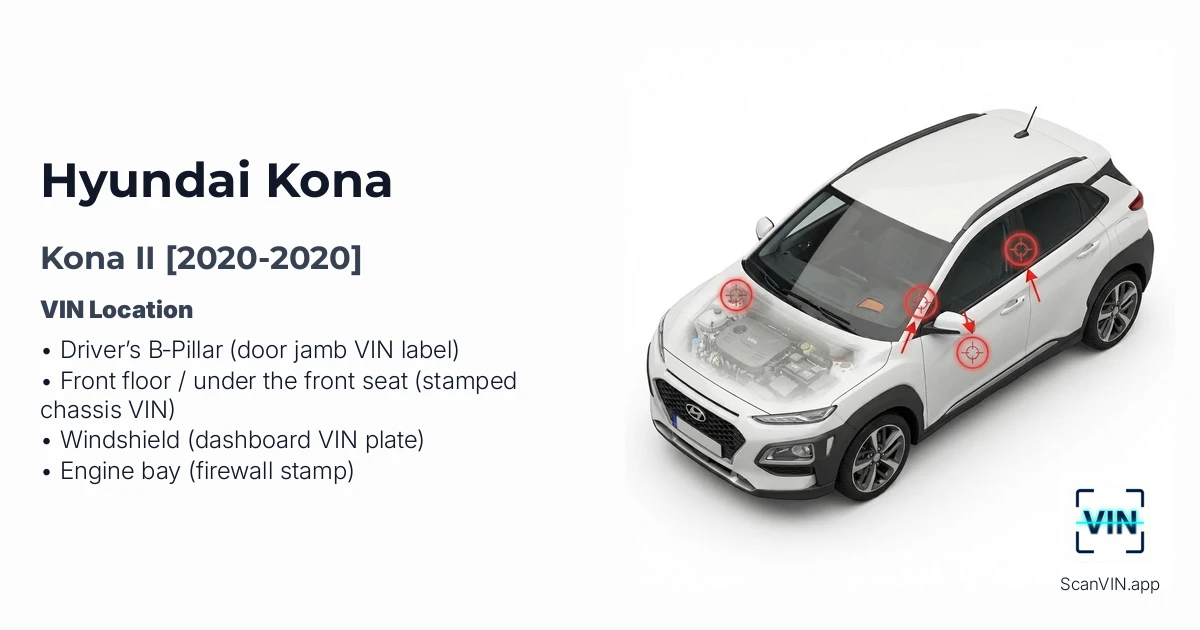 | II 2020 2020 | Driver’s B‑Pillar (door jamb VIN label) Front floor / under the front seat (stamped chassis VIN) Windshield (dashboard VIN plate)
+1 | View details |
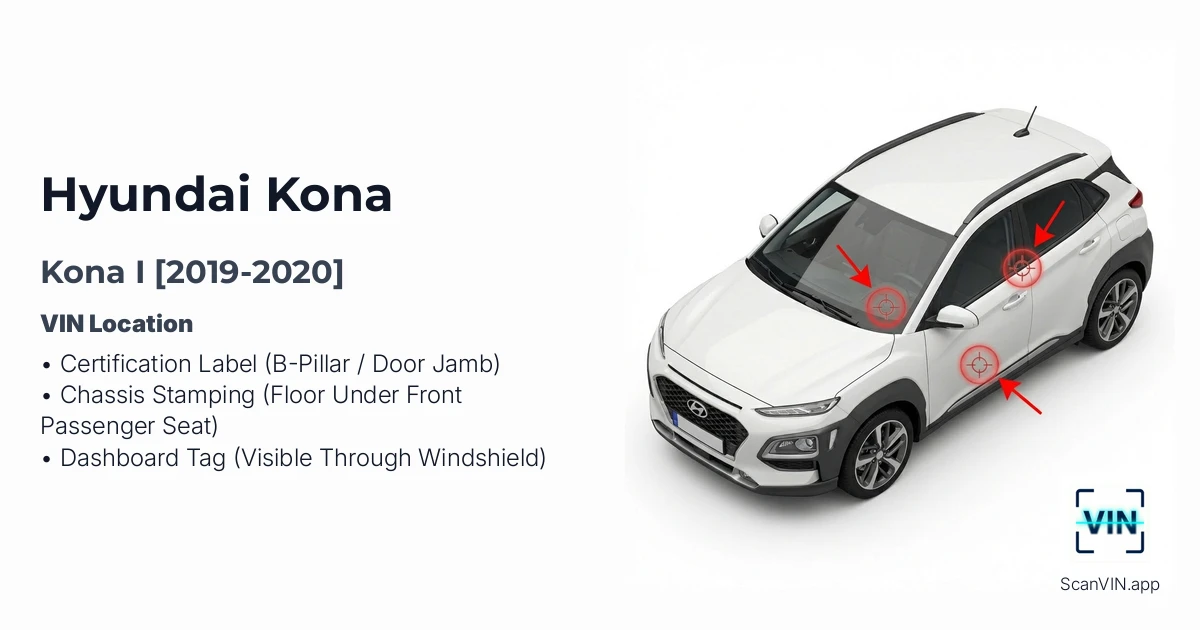 | I 2019 2020 | Certification Label (B-Pillar / Door Jamb) Chassis Stamping (Floor Under Front Passenger Seat) Dashboard Tag (Visible Through Windshield) | View details |
Hyundai Kona II [2020-2020]
Quick response
Quick Answer: The most reliable VIN location for the Hyundai Kona is the driver’s B‑pillar door jamb VIN/certification label. It’s typically located on the vertical pillar between the front and rear doors and is visible when you open the driver’s door. Expert tip: this label is usually the cleanest and highest-contrast VIN, making it the quickest to scan.
This guide covers the VIN number (vehicle identification number) locations for the Hyundai Kona II [2020-2020] produced between 2020–2020, including the fast “open-the-door” label and the hidden stamped chassis VIN.
Chassis Number Locations
Driver’s B‑Pillar (door jamb VIN label) 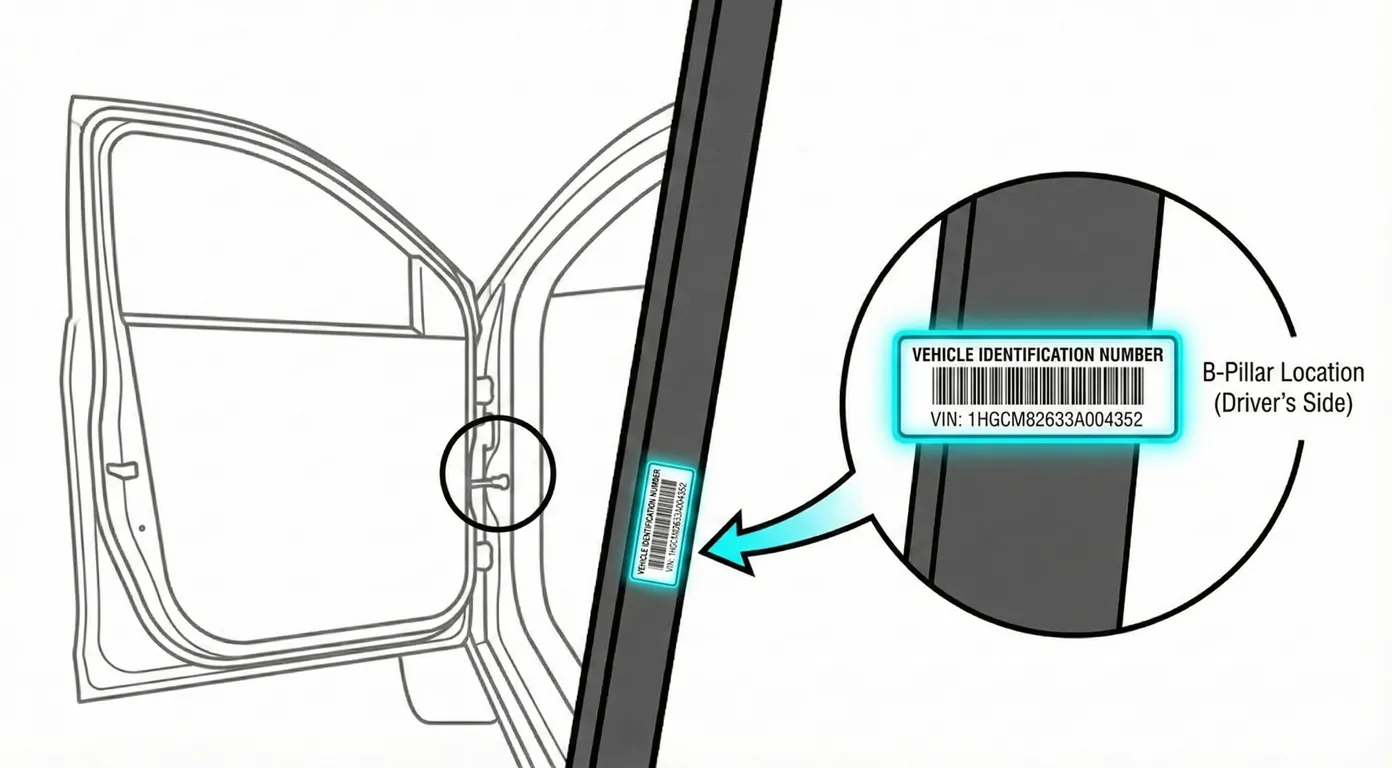
- Where to look: Open the driver’s door and locate the VIN/certification sticker on the B‑pillar (the vertical post between the front and rear doors). It’s typically lower down near the latch/strike area.
- Access: Easiest check—clean, high contrast, no tools needed.
- Note: This location is consistent and is the best first stop for LHD vehicles.
- Tip: Since this is usually the cleanest VIN, scan it directly with your phone to avoid mistyping a character like B/8, S/5, or O/0.
Front floor / under the front seat (stamped chassis VIN) 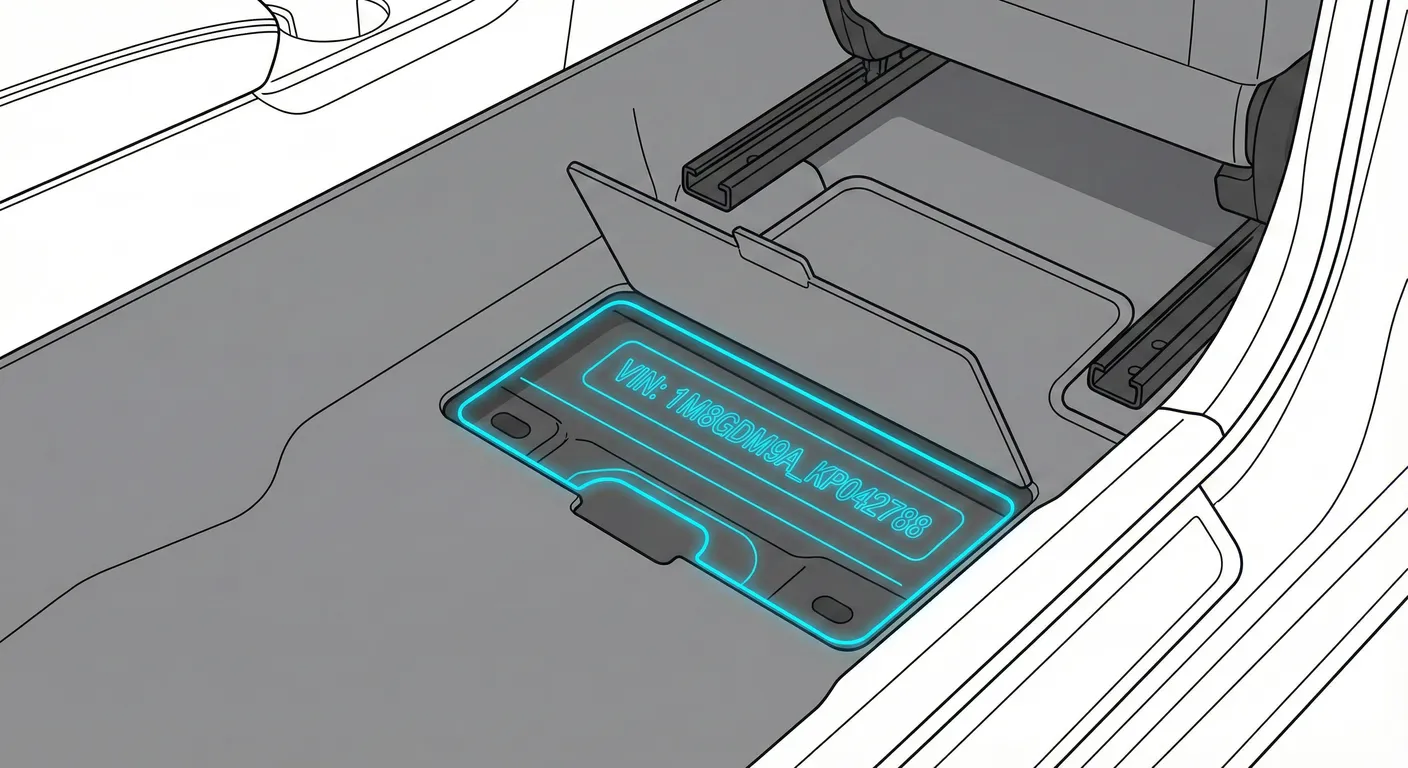
- Where to look: Check the front floor under the seat, using the pre-cut flap in the carpet. Lift the flap and you’ll see the VIN stamped into the chassis cross-member beam.
- Access: The carpet flap can be stiff and wants to fall closed. The area is dark under the seat, and the stamped characters can be low-contrast because they’re painted body color.
- Note: On many vehicles this is found on the right-hand front seat area (commonly the passenger side for LHD vehicles), but check the other front seat area if you don’t find it.
- Tip: Because it’s dark and low-contrast, use Flashlight + OCR—capture it with ScanVin.app instead of squinting at the stamp.
Windshield (dashboard VIN plate) 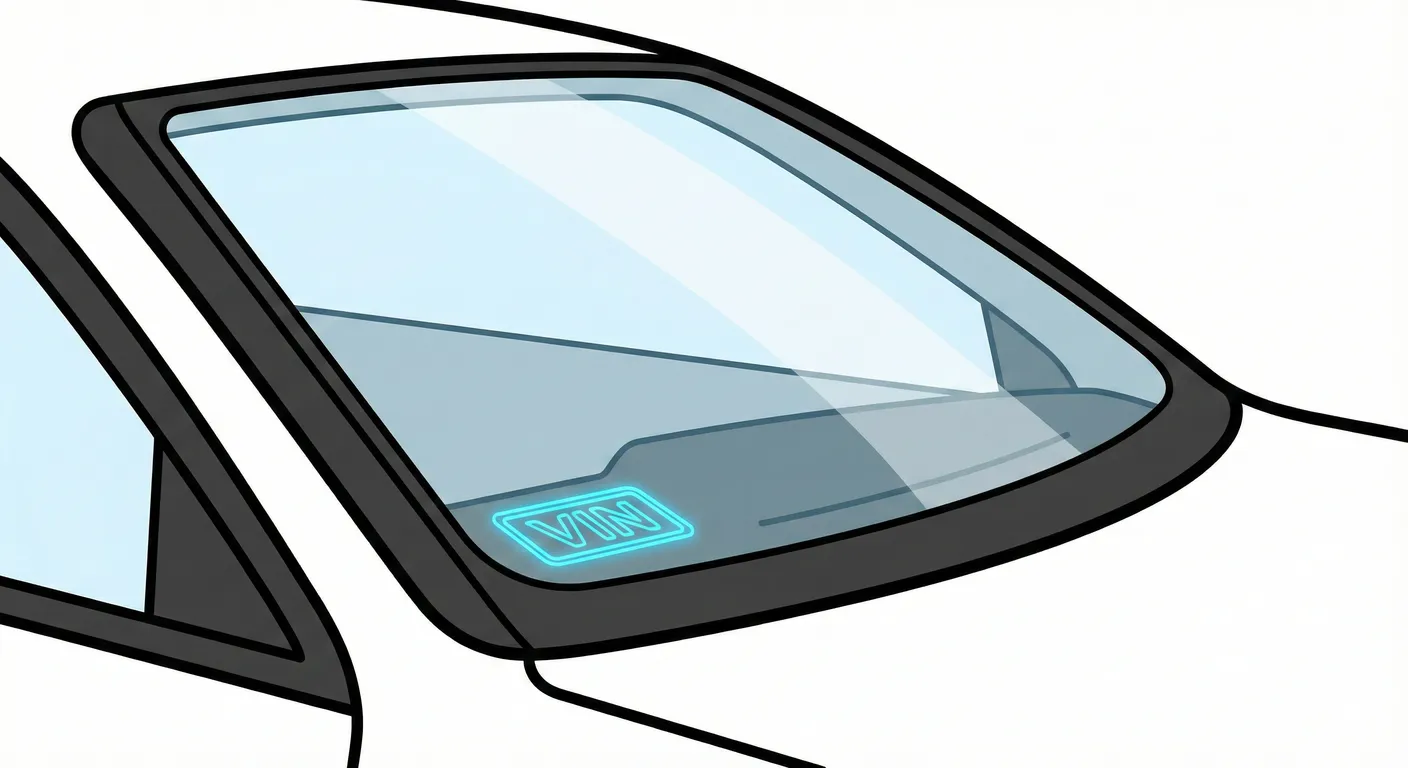
- Where to look: Stand outside the vehicle and look through the bottom corner of the windshield on the driver’s side. The VIN is on a small metal plate/tag embedded in the dashboard.
- Access: Quick to view, but often affected by glare/reflections from the sky and glass angle.
- Note: Best viewed from outside with the camera close to the glass.
- Tip: If glare makes it unreadable, use your phone to scan it instantly so you don’t have to manually transcribe through reflections.
Engine bay (firewall stamp) 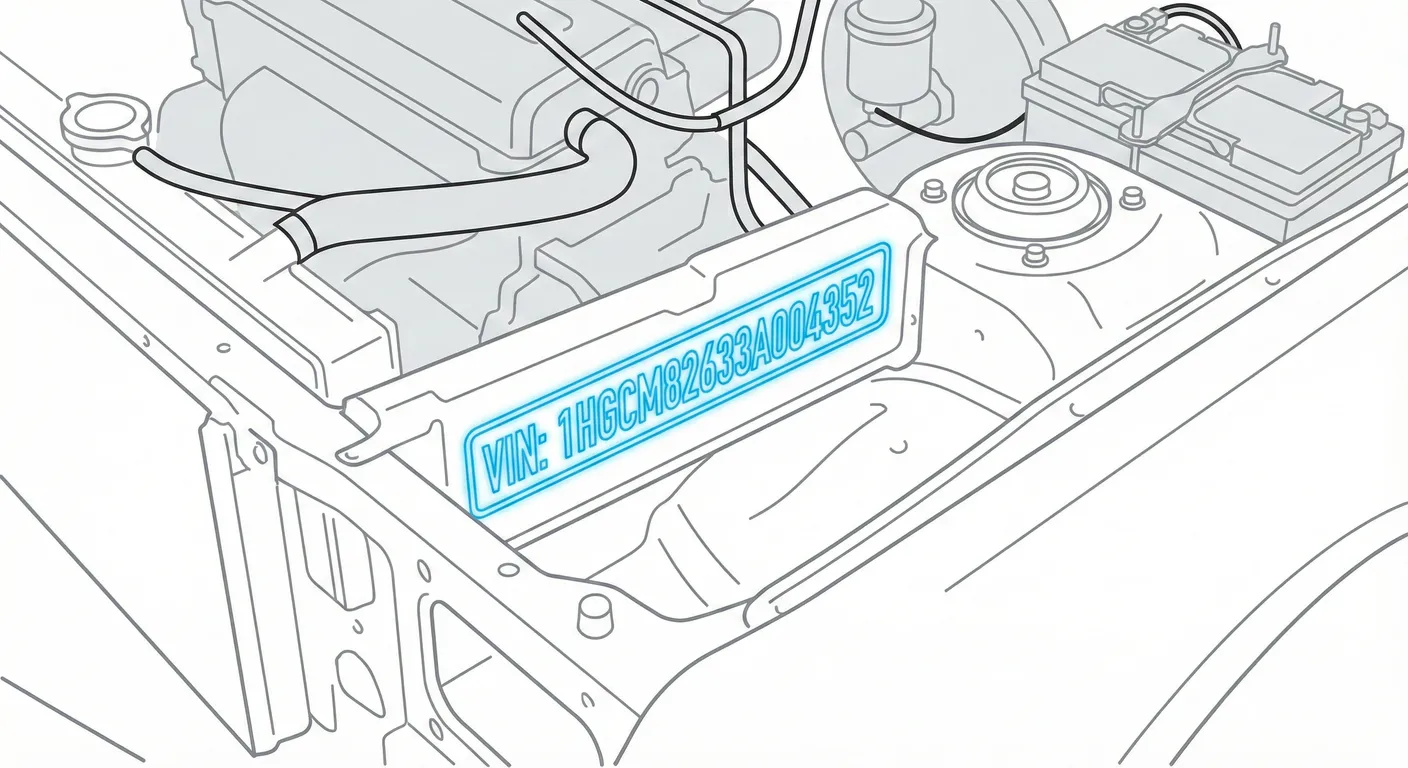
- Where to look: Open the hood and inspect the firewall/bulkhead area (toward the back of the engine bay, near the center or passenger-side area on many Hyundais) for a stamped VIN.
- Access: Can be obscured by hoses, dust, or covers, and may be awkward to photograph.
- Note: This is a secondary verification point—use it if the label is missing or you need to match multiple VIN sources.
- Tip: If it’s hard to reach or partially hidden, scan it with your phone instead of writing it down in an awkward position.
Video Guide
Video Tutorial: Where is the VIN number of my Hyundai Kona ( 2017 - YouTube
- A silent, first-person walkthrough showing the floor/under-seat VIN, the windshield VIN, and the B‑pillar label on a Hyundai Kona.
Common Problems & Troubleshooting
- Under-seat stamped VIN is hard to read: The carpet flap can fight you and the stamped characters may be painted and low-contrast—use a bright light and take a close, steady photo.
- Windshield VIN glare: Reflections from the sky/clouds can wash out characters—change your viewing angle, shade the glass with your hand, and refocus the camera.
- Sticker vs. stamp mismatch: If the B‑pillar label looks tampered with, missing, or doesn’t match other VIN locations, verify using the stamped chassis VIN and run a proper VIN history check before buying.
Frequently Asked Questions
Where is the VIN on Hyundai Kona?
Start with the driver’s B‑pillar door jamb VIN/certification label (open the driver’s door). Also check the stamped chassis VIN under the front seat carpet flap (often on the right-hand front seat area).
Which VIN location is the most important for Hyundai Kona?
The stamped chassis VIN is the hardest to fake and is the best verification source. The B‑pillar label and windshield VIN are convenient for quick checks, but you should confirm they match the stamped VIN when buying a used vehicle.
Hyundai Kona Kona I [2019-2020]
Quick response
Quick Answer: The most reliable VIN location for the Hyundai Kona is the certification label on the driver’s side B-pillar (door jamb). It is typically a black sticker with white text visible when you open the driver’s door. Expert tip: scan it first because it has high contrast and is usually easier to read than the floor stamping.
This guide shows where to find the VIN (Vehicle Identification Number) on the Hyundai Kona I (2019–2020), including the easiest scan points and the hidden stamped chassis number used for identity checks.
Chassis Number Locations
Certification Label (B-Pillar / Door Jamb)
- Where to look: Open the driver’s door and look on the lower section of the driver-side B-pillar. You’ll find a black sticker with white text (certification label) that includes the VIN.
- Access: Very easy access—no tools. The only issue is wear/scuffs (seatbelt buckle hits, shoe scuffs) that can damage the sticker.
- Note: This location is consistent and is typically the best scanning target because of the strong contrast.
- Tip: If the sticker is slightly scratched, scan it directly with your phone using ScanVin.app to avoid misreading similar characters like B/8 or O/0.
Chassis Stamping (Floor Under Front Passenger Seat)
- Where to look: Inside the cabin on the floor under the front right seat (commonly the passenger side for LHD vehicles). The VIN is stamped into the cross-member and is hidden under a pre-cut rectangular carpet flap held down by Velcro. The stamping is often painted in body color, so it can look “flat.”
- Access: Slide the front seat fully back (or forward depending on your reach), then lift the carpet flap. It’s usually dark/shadowed under the seat, so bring a light.
- Note: For RHD markets, Hyundai often keeps this stamping on the right-side cross-member as well—if you don’t find it on the right, check the opposite footwell area before assuming it’s missing.
- Tip: Because it’s shadowed and low-contrast (painted metal), use the Flashlight + OCR scan on ScanVin.app so you don’t have to kneel and manually copy the characters.
Dashboard Tag (Visible Through Windshield)
- Where to look: From outside the vehicle, look through the windshield at the lower corner on the driver’s side where the VIN plate sits on top of the dashboard.
- Access: Easy to reach, but hard to read in bright conditions due to glare/reflections on the glass; wiper position can partially block the view.
- Note: This is a quick “spot-check” VIN, but always verify against the door sticker and/or floor stamping when buying or inspecting.
- Tip: If reflections wash out the characters, shade the glass with your hand and capture it instantly with ScanVin.app to prevent transcription errors.
Video Guide
Video Tutorial: Where is the VIN number of my Hyundai Kona ( 2017 - YouTube
- A concise walkthrough showing the floor stamping under the seat, the windshield VIN plate, and the B-pillar certification label.
Common Problems & Troubleshooting
- Floor VIN is hard to see: The stamping sits under the seat and is shadowed; slide the seat fully and use a flashlight to avoid missing digits on the painted metal.
- Windshield VIN glare: Sun/sky reflections and curved glass can hide characters; shade the plate and change viewing angle until the full VIN is sharp.
- Sticker vs. stamped VIN mismatch: A damaged/replaced B-pillar label can be misleading—always cross-check the floor stamping when verifying vehicle identity.
Frequently Asked Questions
Where is the VIN on Hyundai Kona?
Check the certification label on the driver’s side B-pillar (door jamb). You can also find a stamped chassis VIN under the front right seat beneath a Velcro-held carpet flap, and a VIN plate visible through the driver-side lower windshield.
Which VIN location is the most important for Hyundai Kona?
For inspections and identity verification, the stamped chassis VIN (floor under the seat) is the strongest physical identifier. For quick checks and scanning convenience, the B-pillar certification label is usually the easiest and clearest.
Don't see your generation?
Try scanning simple VIN code. Our scanner will automatically identify the Make, Model and Generation.
Scan VINNote on Data Sources
Information about VIN location in this model comes from aggregation of official technical documentation (OEM) and spare parts catalogs. Despite careful algorithmic verification, the data is for reference purposes only. Final vehicle identification should always be confirmed by an authorized technician.
See how we verify data and build our database →