
Where is the VIN in the Kia Rio?
Select your car's generation to see the exact VIN number locations
VIN Location Overview for Kia Rio
2 generationsSelect the generation of your car to see the exact VIN number locations
| Generation & Years | Typical VIN Locations | Details | |
|---|---|---|---|
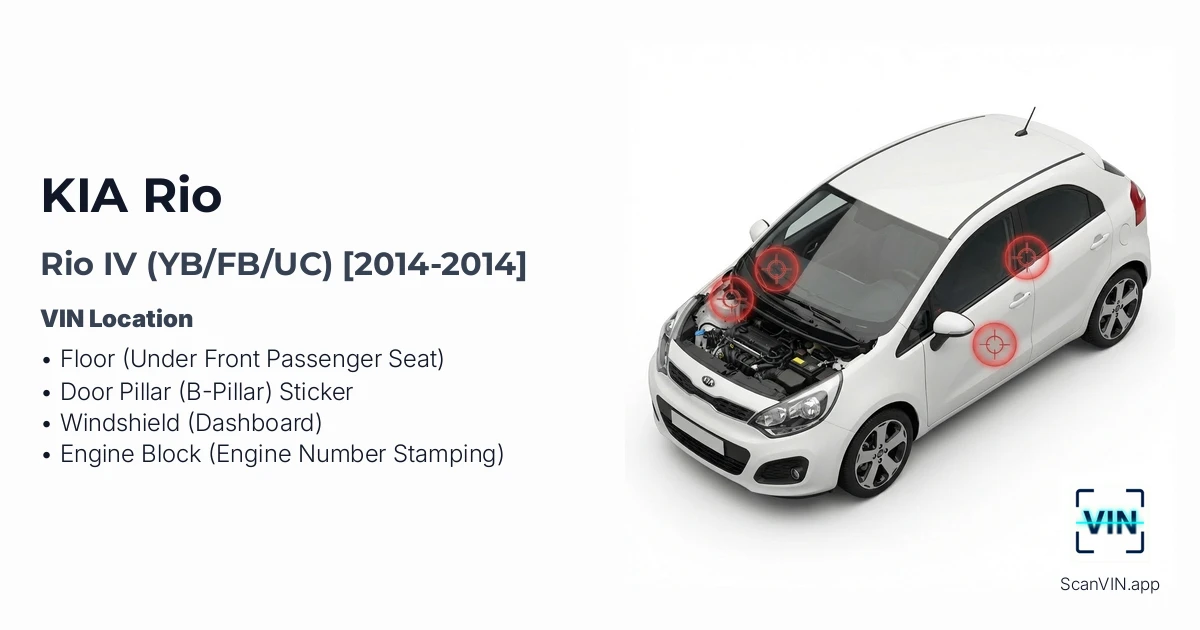 | IV Ybfbuc 2014 2014 | Floor (Under Front Passenger Seat) Door Pillar (B-Pillar) Sticker Windshield (Dashboard)
+1 | View details |
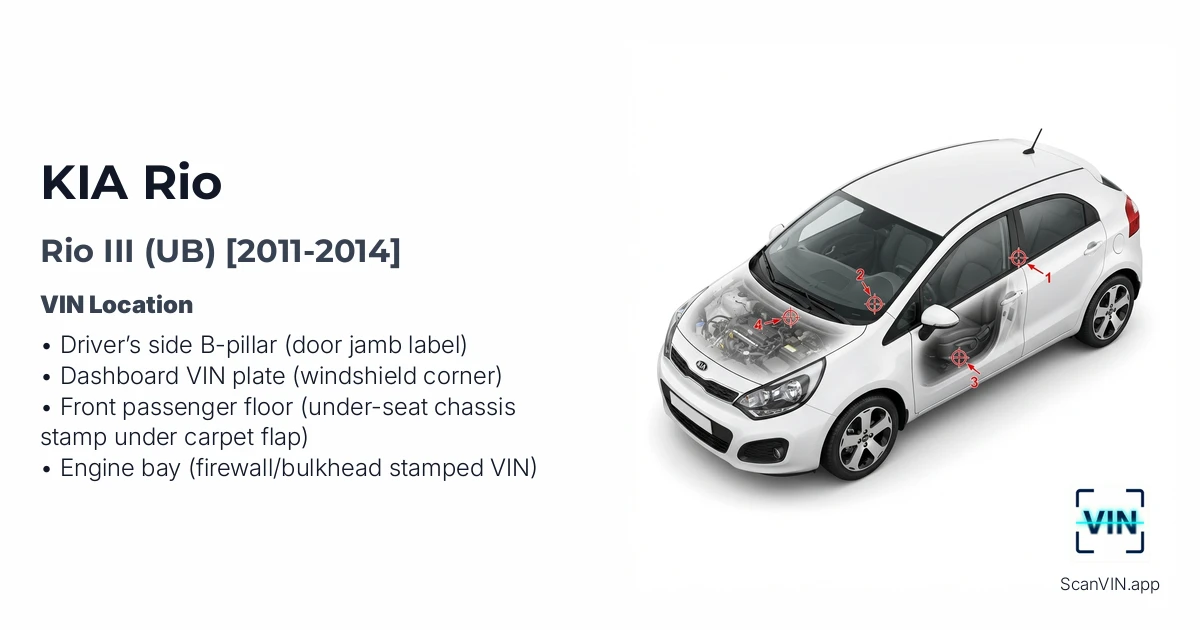 | III Ub 2011 2014 | Driver’s side B-pillar (door jamb label) Dashboard VIN plate (windshield corner) Front passenger floor (under-seat chassis stamp under carpet flap)
+1 | View details |
Kia Rio IV (YB/FB/UC) [2014-2014]
Quick response
Quick Answer: The most reliable VIN location for the KIA Rio is the VIN stamped into the floor cross-member under the front passenger seat. It’s hidden under a pre-cut carpet flap—slide the seat fully back and use a flashlight because it’s usually dark under there.
This guide covers the VIN (chassis number) locations for the KIA Rio IV (YB/FB/UC) [2014-2014], including the easiest label to check and the tamper-resistant stamped VIN hidden under the carpet.
Chassis Number Locations
Floor (Under Front Passenger Seat) 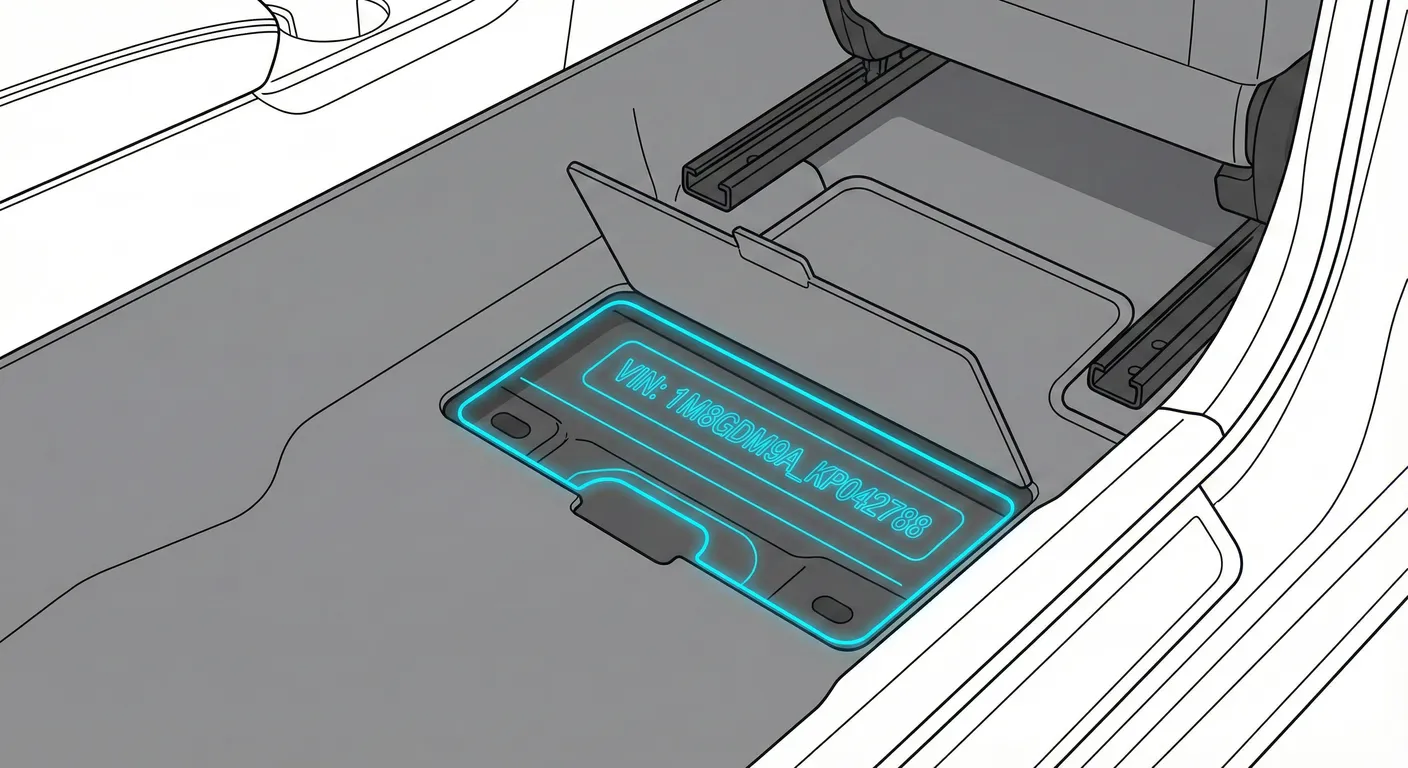
- Where to look: The VIN is stamped into the metal floor cross-member beneath the front passenger seat, hidden under a rectangular, pre-cut flap in the carpet. Slide the seat all the way back, then lift the carpet flap from the front/side to expose the stamping.
- Access: Typically dark and cramped. You’ll need to move the seat, lift a dusty flap, and keep it open while reading/scanning (the flap often drops back down).
- Note: Written for LHD: this is commonly on the passenger side (right/front seat in LHD). On RHD, it’s still under the front passenger seat (left/front seat in RHD).
- Tip: Because it’s shadowy and awkward to read one-handed, use the flashlight + OCR to scan the VIN directly with your phone instead of trying to transcribe it off the floor.
Door Pillar (B-Pillar) Sticker 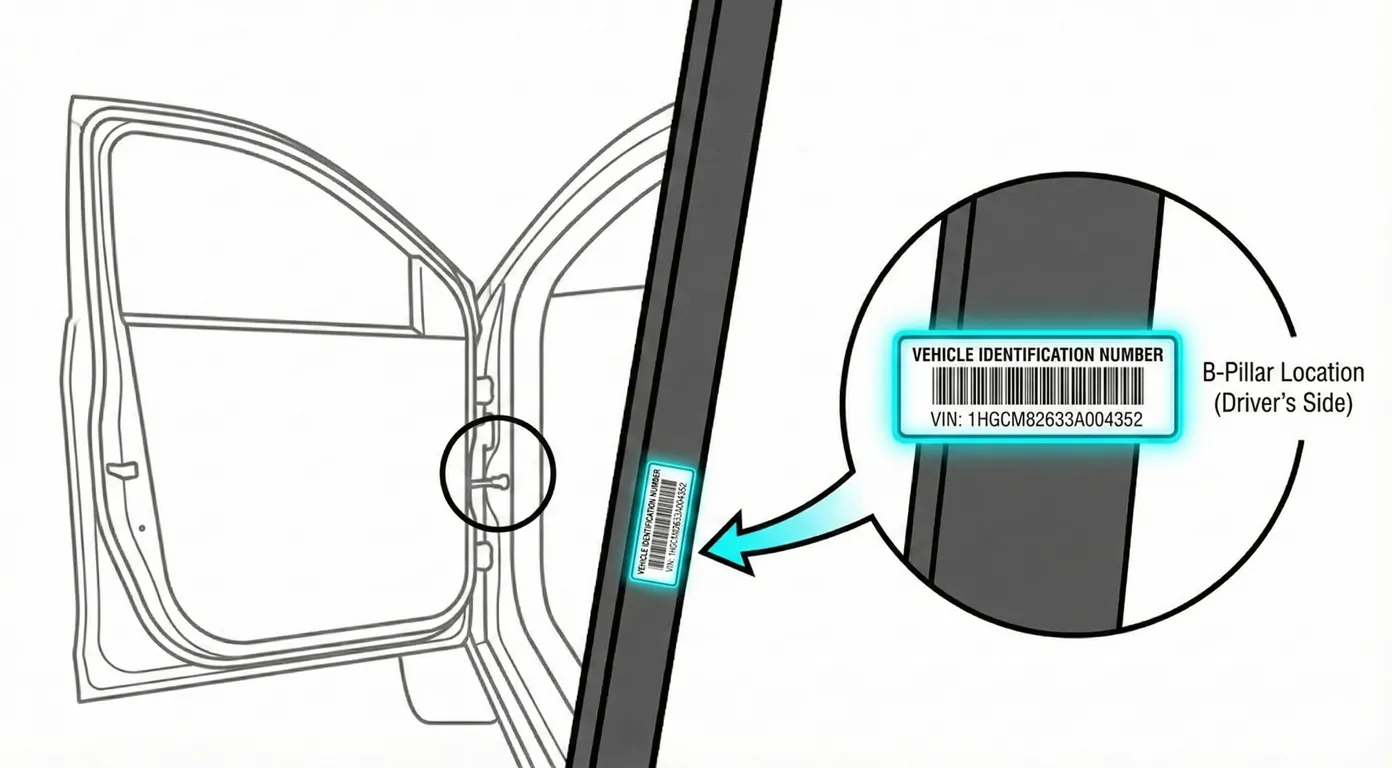
- Where to look: Open the front door and check the lower B-pillar (center pillar) for a black VIN label that also lists paint/weight information.
- Access: Fastest check—good visibility with the door fully open—but labels can be faded, scratched, or peeling over time.
- Note: Often found on the passenger-side B-pillar in LHD markets, but if you don’t see it there, check the other side.
- Tip: If the label is intact, it’s the quickest win—use the free VIN reader to capture the VIN cleanly from the vertical sticker without typing errors.
Windshield (Dashboard) 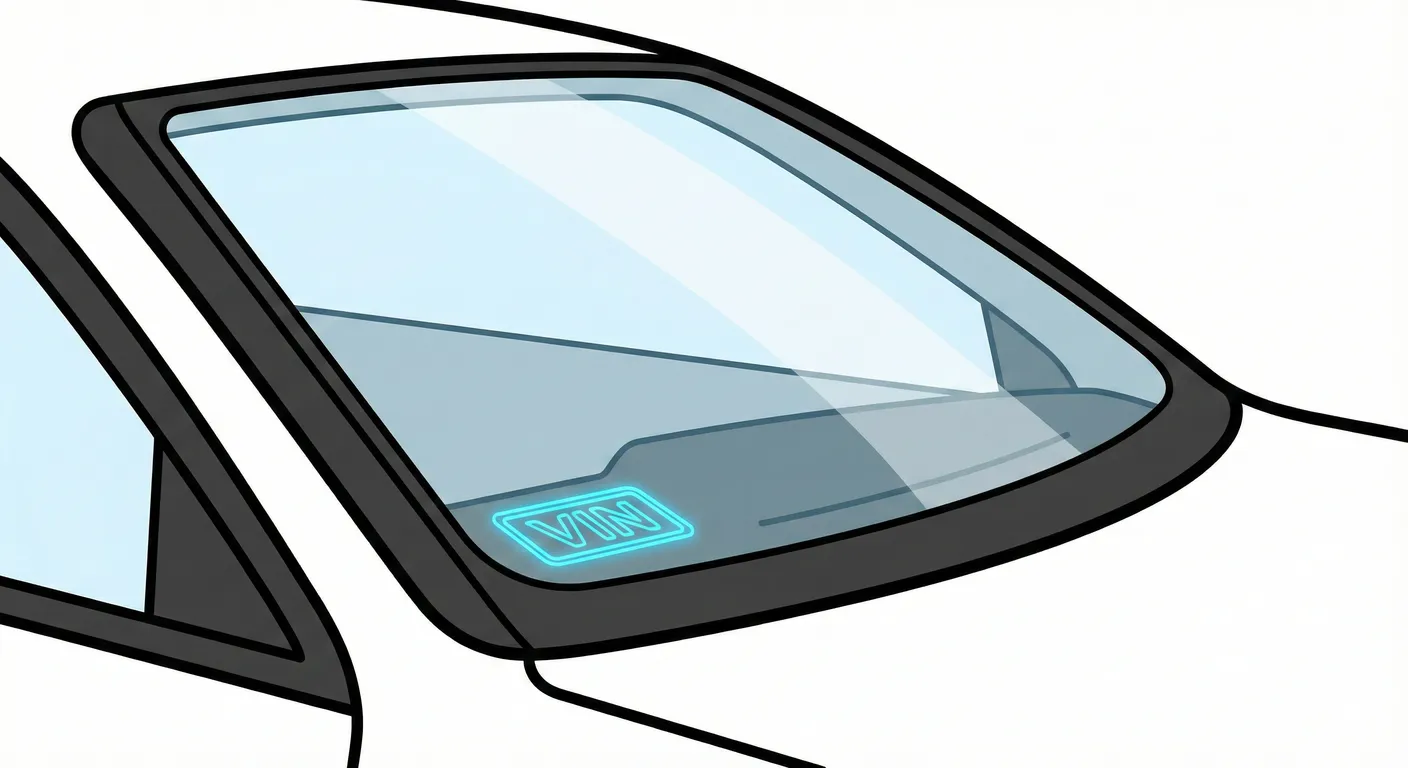
- Where to look: Look through the bottom corner of the windshield on the driver’s side for the VIN plate visible from outside the car.
- Access: Easy to reach, but reflections/glare on the glass can make photos unreadable.
- Note: Best checked in shade or with the phone angled to reduce reflections.
- Tip: If glare is washing out characters, capture it instantly with your phone so the app can grab the VIN before reflections shift.
Engine Block (Engine Number Stamping) 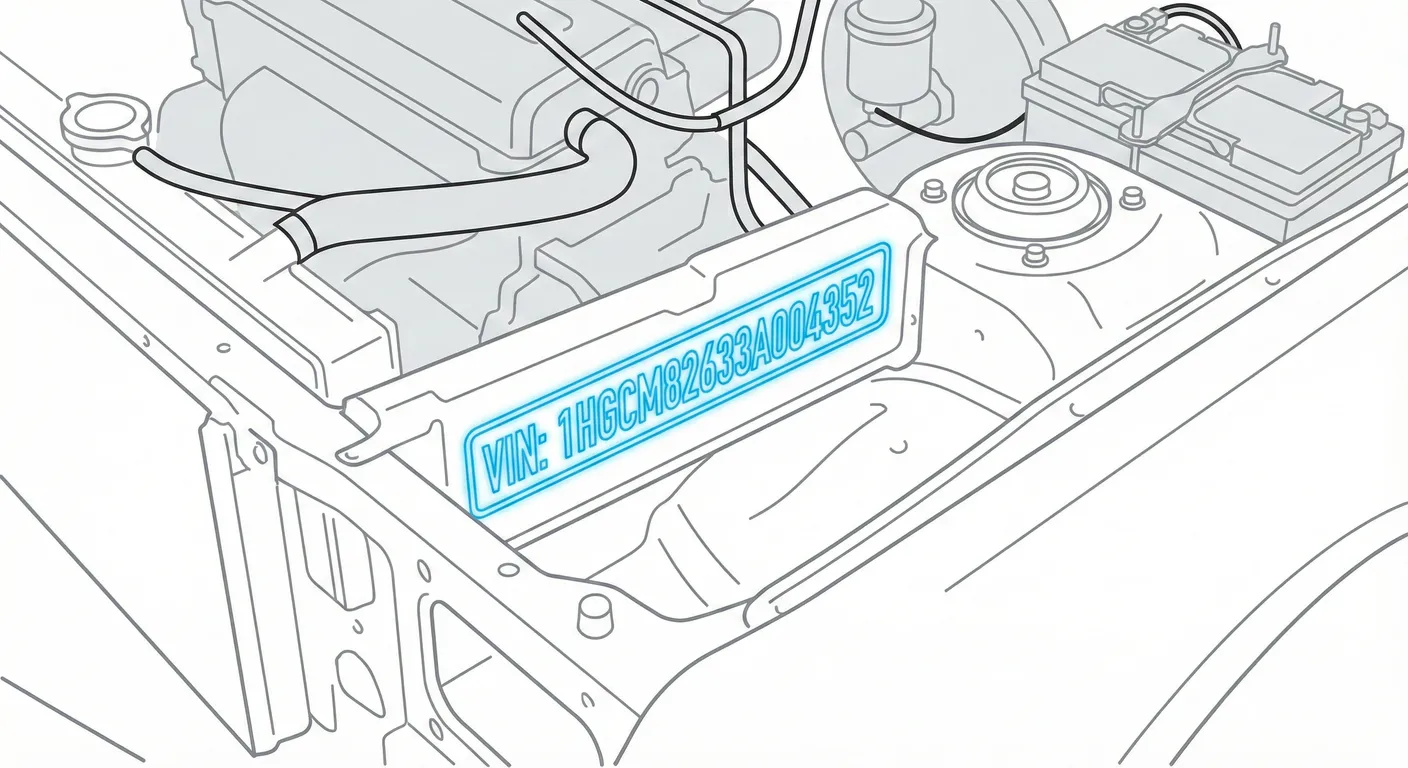
- Where to look: A number is stamped on a flat machined surface of the engine block, typically near the transmission bell housing/junction area (often buried behind hoses/wiring).
- Access: Extreme difficulty for DIY checks—deep in the bay, commonly greasy, and hard for a phone camera to autofocus through obstructions. You may need a flashlight and cleaning to read it.
- Note: This is mainly useful for mechanical verification (e.g., engine identity/engine swap checks), not the quickest place to confirm the vehicle VIN.
- Tip: If the stamping is oily or faint, wipe it and then use ScanVin’s high-contrast scan to help decipher worn characters without guessing.
Video Guide
Video Tutorial: 2014 kia Rio vin number and engine number locations
- Steady walkthrough showing the under-seat floor VIN, the door sticker, and detailed engine bay stamping footage.
Video Tutorial: Where is the VIN number of my Kia Rio III ( 2011 – 2016 )
- Quick POV demo of sliding the seat back and lifting the carpet flap to reveal the stamped floor VIN (LHD example).
Common Problems & Troubleshooting
- Carpet flap won’t stay open (floor VIN): Slide the seat fully back and use one hand to hold the flap while scanning; dirt buildup can make the flap stick—wipe around the edges first.
- Engine stamping is unreadable: Grease and hoses block the view—use a flashlight, clean the pad with a rag/brake cleaner, and try again (don’t scrape hard enough to remove characters).
- B-pillar sticker isn’t “proof” by itself: Labels can be replaced or damaged—always cross-check the sticker VIN against the stamped floor VIN and your registration/title.
Frequently Asked Questions
Where is the VIN on KIA Rio?
Start with the VIN sticker on the lower B-pillar when you open the front door, then confirm the stamped VIN under the front passenger seat beneath the carpet flap.
Which VIN location is the most important for KIA Rio?
The stamped VIN in the body/chassis (under the carpet on the floor cross-member) is the most important to confirm because it’s the hardest to alter compared to a sticker.
Kia Rio UB
Quick response
Quick Answer: The most reliable VIN location for the KIA Rio III (UB) is the VIN certification label on the driver’s side B-pillar (door jamb). It’s visible when you open the driver’s door, just below the latch striker area. It’s usually easy to read and scan, but older labels can fade or peel.
This guide shows the VIN number locations for the KIA Rio III (UB) produced between 2011–2014, including the quickest label location and the hidden stamped chassis locations.
Chassis Number Locations
Driver’s side B-pillar (door jamb label)
- Where to look: Open the driver’s door and look on the B-pillar. The black VIN certification label sits below the door latch striker and is clearly visible with the door open.
- Access: Very easy—no tools needed. If the sticker is old, check for fading, peeling, or dirt film.
- Note: This is a standard, easy-to-check VIN label on LHD cars (like the examples shown).
- Tip: If the label is readable but you don’t want to mistype it, scan it directly with your phone on the flat sticker surface for fast OCR results.
Dashboard VIN plate (windshield corner)
- Where to look: Check the lower corner of the windshield on the left side (driver’s side for LHD). The VIN is visible through the glass from outside the vehicle.
- Access: Easy—no tools. The main issue is glare/reflections on the windshield.
- Note: Best checked from outside in daylight; angle matters.
- Tip: To beat windshield glare and avoid transcription mistakes, capture it with the VIN scanner and let OCR grab the characters instantly.
Front passenger floor (under-seat chassis stamp under carpet flap)
- Where to look: In the front footwell floor area under the front passenger seat, there’s usually a pre-cut carpet flap/slit. The VIN is stamped into the metal cross-member underneath.
- Access: Medium difficulty. Slide the front passenger seat all the way back, locate the carpet slit, then lift/pull the flap to expose the stamping. Expect low contrast and shadows under the seat.
- Note: On LHD cars, this is commonly on the passenger side, but if you don’t find it there, check the driver side footwell as well (some markets/variants differ).
- Tip: This spot is dark and the stamping can blend into the paint—use Flashlight + OCR and scan it with the free VIN reader once the flap is lifted.
Engine bay (firewall/bulkhead stamped VIN)
- Where to look: Open the hood and look at the firewall/bulkhead, low and slightly right of center (when you’re facing the engine). The VIN is stamped into the chassis metal and can be partly hidden behind hoses/wiring/intake plumbing.
- Access: High difficulty. It’s deep, dark, and obstructed, and it often gets dusty/greasy. You’ll likely need a flashlight and a quick wipe with a rag.
- Note: Don’t confuse terms: some people call this “engine number,” but this is the VIN stamped on the body/chassis (the actual engine serial is on the engine block).
- Tip: Because it’s cramped and dirty, clean the area lightly and use High Contrast AI Mode to scan it so you don’t have to write it down while leaning over the engine.
Video Guide
Video Tutorial: Where is the VIN number of my Kia Rio III ( 2011 – 2016 ) - YouTube
- Quick, clear walkthrough showing the driver’s side B-pillar VIN label with good lighting and stable footage.
Video Tutorial: kia rio 2012 engine number and chassis number location ... - YouTube
- Detailed demonstration of the hard-to-see firewall stamping and the exact carpet flap method for the under-seat chassis VIN.
Common Problems & Troubleshooting
- Under-seat floor VIN is hard to read: The stamping is often low-contrast and in shadow—slide the seat back fully, lift the flap completely, and use a flashlight.
- Firewall VIN is buried/dirty: Expect hoses and wiring blocking the view plus grime—wipe the metal and use a strong light to make the characters pop.
- Sticker VIN isn’t “proof” by itself: If the B-pillar label is missing, damaged, or looks tampered, cross-check with a stamped VIN (floor/firewall) before buying or registering the car.
Frequently Asked Questions
Where is the VIN on KIA Rio III?
Start with the driver’s side B-pillar VIN label (door jamb). You can also find the VIN through the windshield on the dashboard corner, plus stamped VINs under the front passenger seat (under a carpet flap) and on the firewall in the engine bay.
Which VIN location is the most important for KIA Rio III?
For verification, the stamped VIN on the body/chassis (under-seat floor stamping or the firewall stamping) is the most important because it’s physically stamped into the vehicle structure and is harder to alter than a sticker.
Don't see your generation?
Try scanning simple VIN code. Our scanner will automatically identify the Make, Model and Generation.
Scan VINNote on Data Sources
Information about VIN location in this model comes from aggregation of official technical documentation (OEM) and spare parts catalogs. Despite careful algorithmic verification, the data is for reference purposes only. Final vehicle identification should always be confirmed by an authorized technician.
See how we verify data and build our database →