
Where is the VIN in the Mazda 3?
Select your car's generation to see the exact VIN number locations
VIN Location Overview for Mazda 3
4 generationsSelect the generation of your car to see the exact VIN number locations
| Generation & Years | Typical VIN Locations | Details | |
|---|---|---|---|
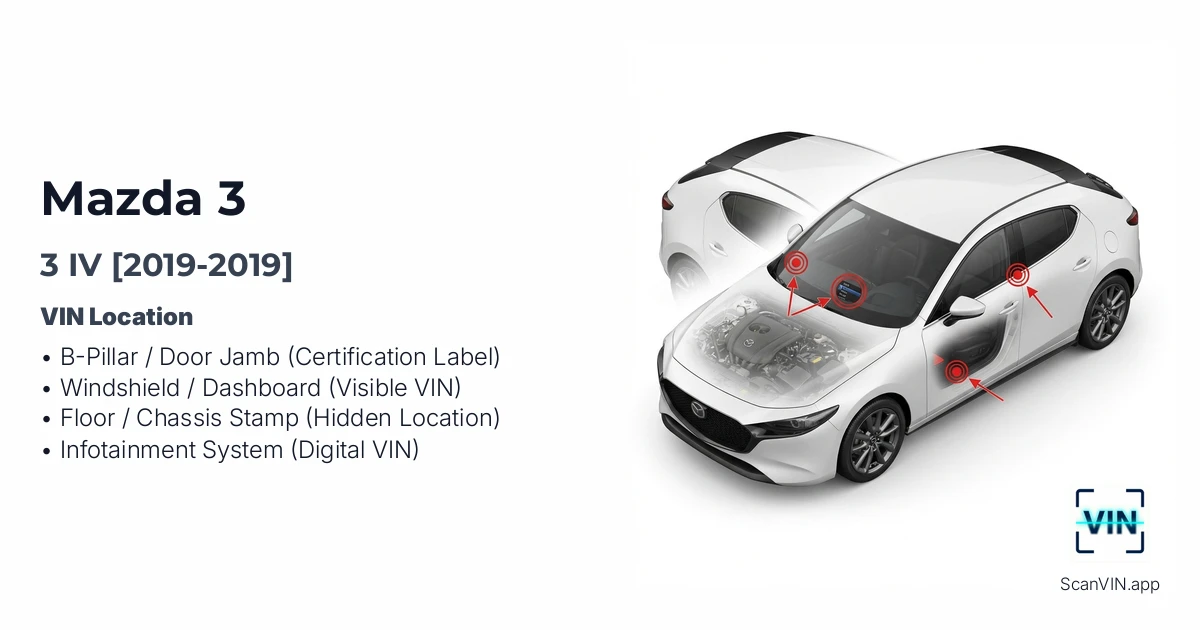 | IV 2019 2019 | B-Pillar / Door Jamb (Certification Label) Windshield / Dashboard (Visible VIN) Floor / Chassis Stamp (Hidden Location)
+1 | View details |
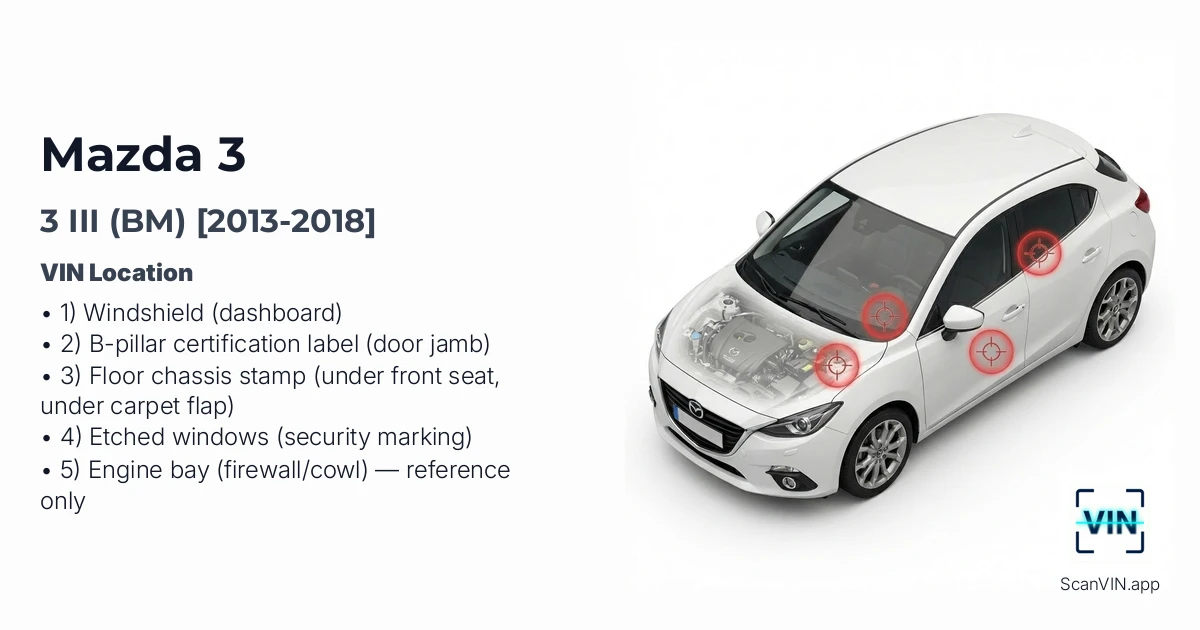 | III Bm 2013 2018 | 1) Windshield (dashboard) 2) B-pillar certification label (door jamb) 3) Floor chassis stamp (under front seat, under carpet flap)
+2 | View details |
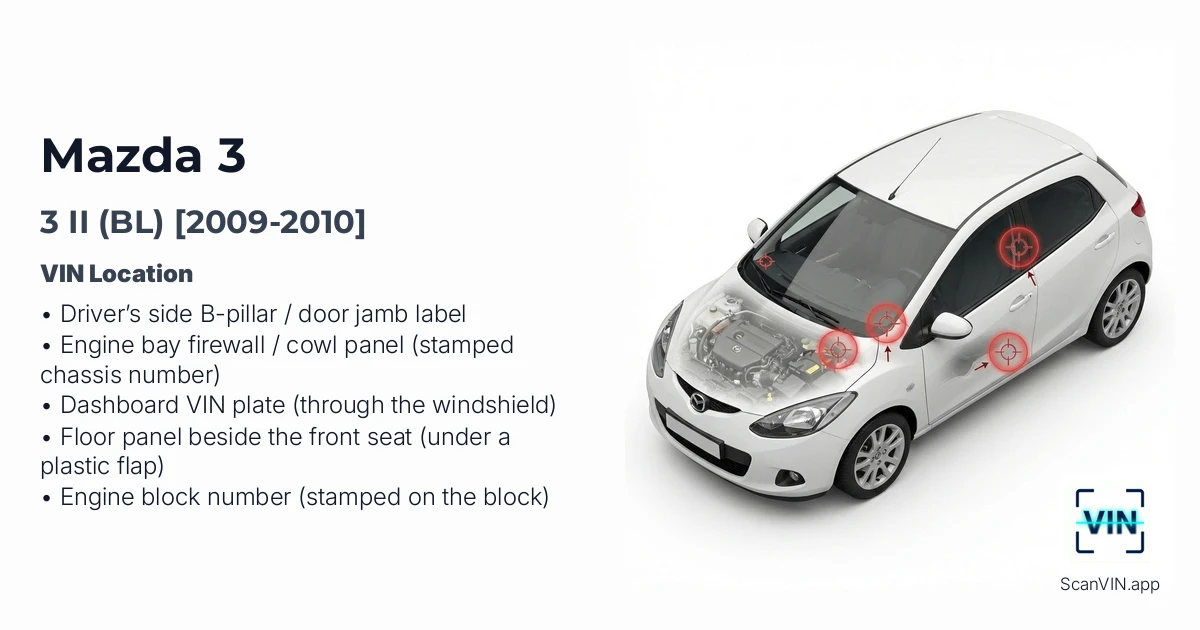 | II Bl 2009 2010 | Driver’s side B-pillar / door jamb label Engine bay firewall / cowl panel (stamped chassis number) Dashboard VIN plate (through the windshield)
+2 | View details |
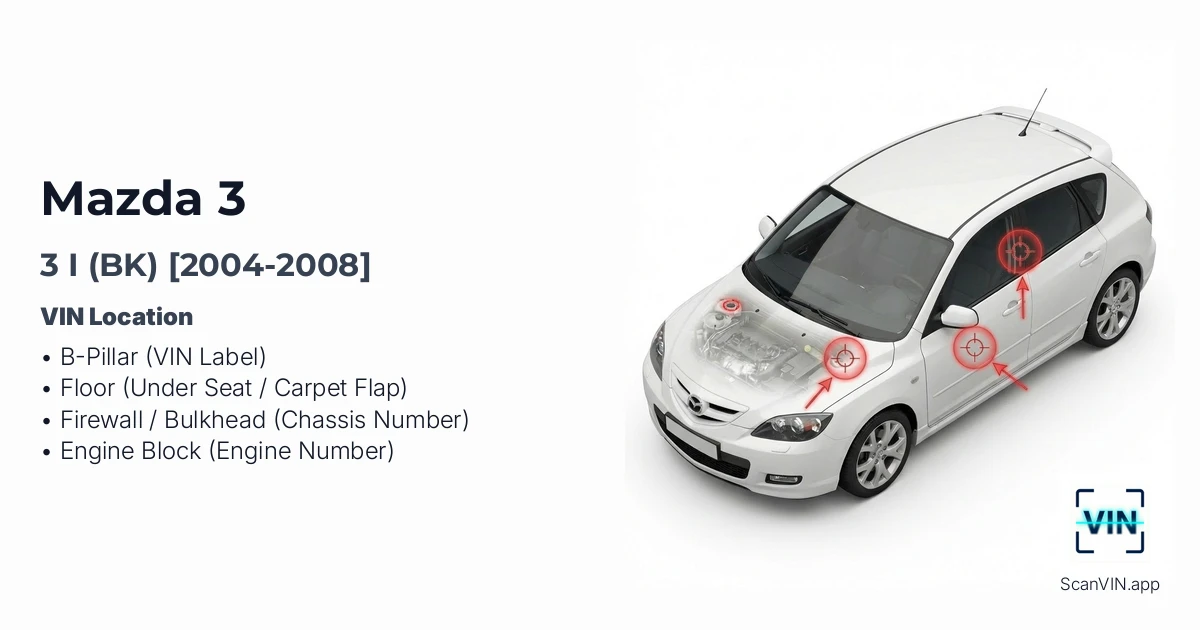 | I Bk 2004 2008 | B-Pillar (VIN Label) Floor (Under Seat / Carpet Flap) Firewall / Bulkhead (Chassis Number)
+1 | View details |
IV 2019 2019
III Bm 2013 2018
II Bl 2009 2010
I Bk 2004 2008
Mazda 3 IV [2019-2019]
Quick response
Quick Answer: The most reliable VIN location for the Mazda 3 is the Driver’s-side B-pillar / door jamb certification label. It’s a black/white sticker near the door latch area and usually scans easily with the door open.
This guide covers the VIN number locations for the Mazda 3 IV produced between 2019–2019, including the easiest scan points and the hidden chassis stamp used for legal verification.
Chassis Number Locations
B-Pillar / Door Jamb (Certification Label) 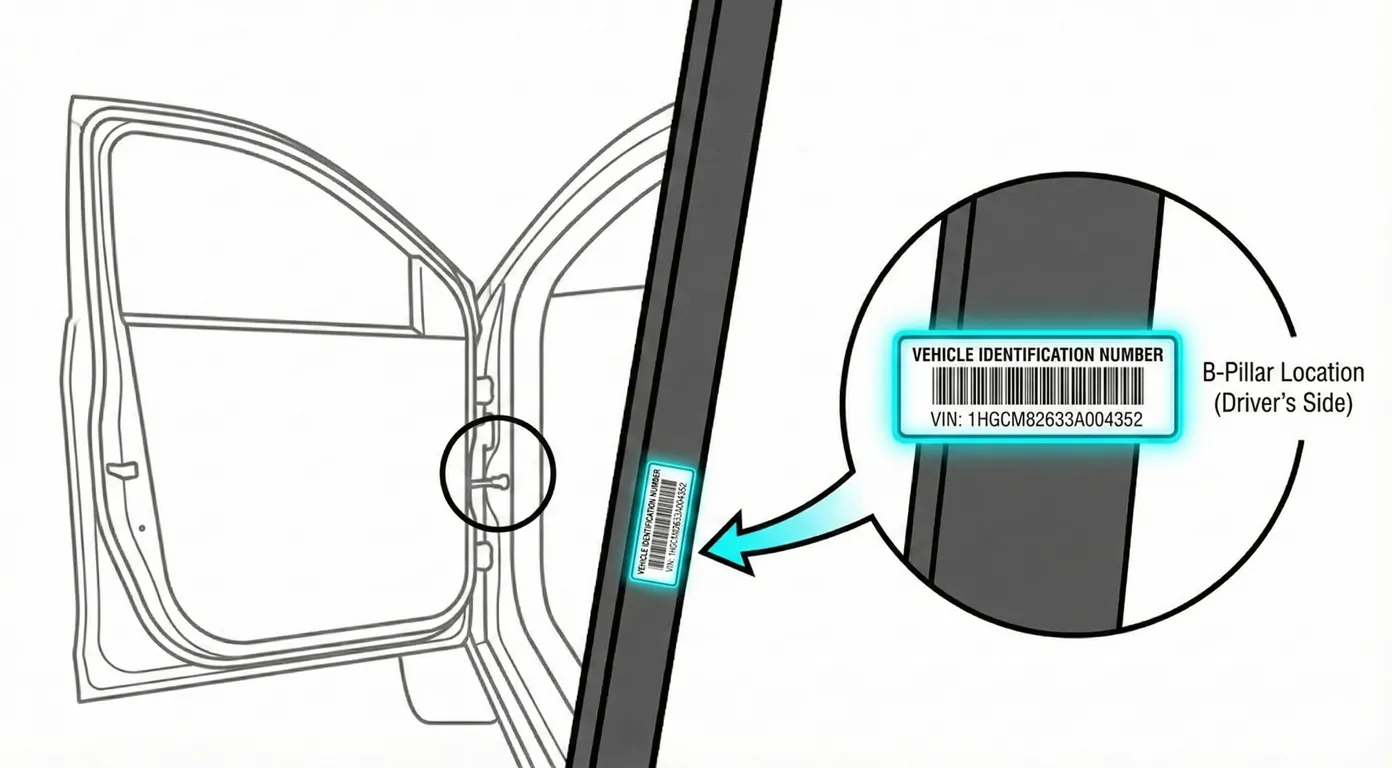
- Where to look: Open the driver’s door and look on the B-pillar (the post between the front and rear doors), near the door latch mechanism. You’ll see a black or white sticker with the VIN plus tire pressure and paint code details (often with a barcode).
- Access: Low difficulty. Typically clean and well-lit with the door open, but the barcode can get worn from age/seatbelt strikes.
- Note: This is usually the best primary scanning target because it has strong contrast and often includes a barcode.
- Tip: If the barcode is scuffed or the print is faded, **use a close, steady shot and let the camera do the work—**you can scan the label instantly with your phone instead of trying to read damaged characters.
Windshield / Dashboard (Visible VIN) 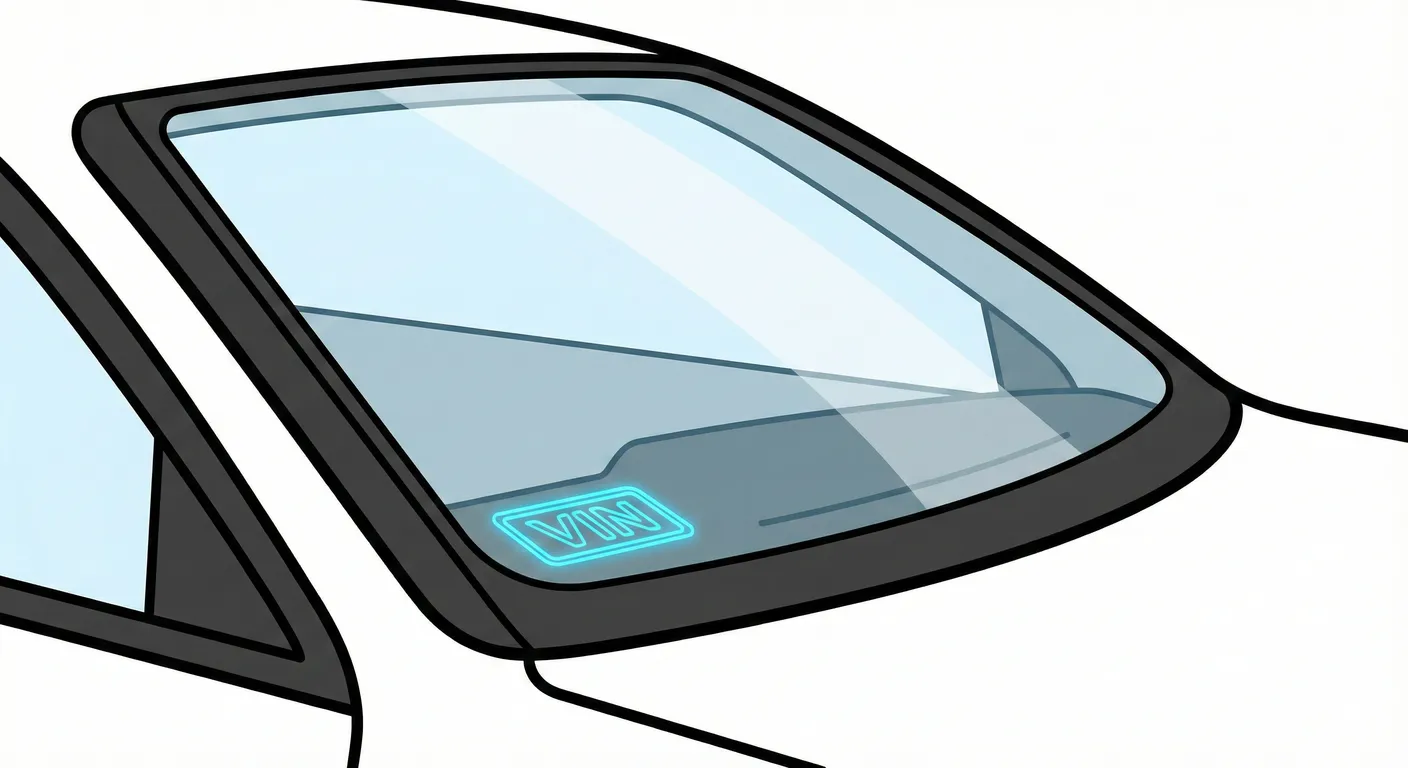
- Where to look: From outside the car, look through the lower corner of the windshield on the driver’s side. The VIN is on a metal plate riveted to the dashboard cowl.
- Access: Medium difficulty. The VIN is visible, but glare/reflections can be high depending on sun angle and dashboard texture.
- Note: In some markets the windshield VIN may be absent/blank; if you don’t see it, move straight to the door-jamb label or the floor stamp.
- Tip: When glare washes out the numbers, change your angle and distance, then capture the VIN cleanly with the camera scanner instead of manually squinting through reflections.
Floor / Chassis Stamp (Hidden Location) 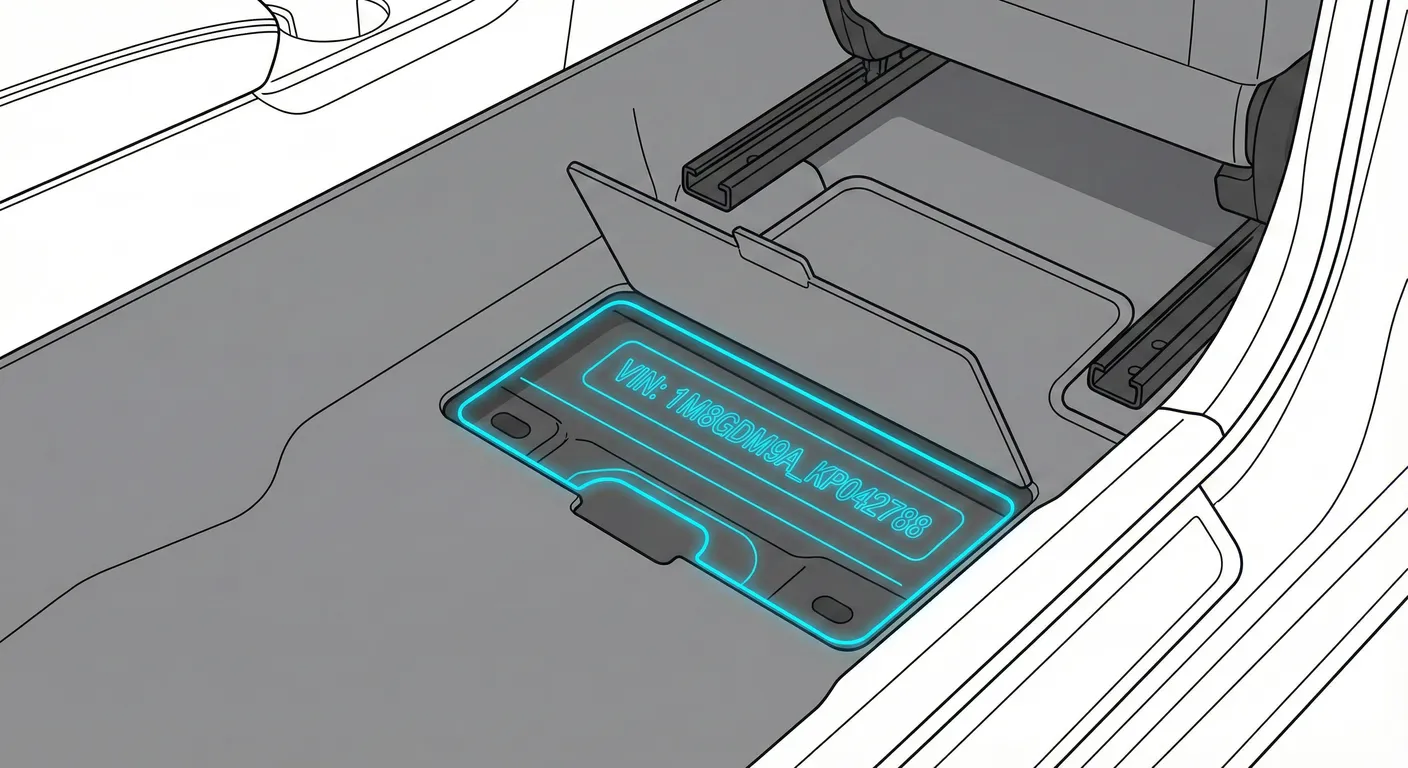
- Where to look: Check the front right-side footwell floor area (commonly the passenger side on LHD vehicles). Look for a plastic cover/flap or a pre-cut carpet section marked like “VIN” or “FRAME NO”, then lift the flap / pull back the carpet to reveal the VIN stamped into the chassis metal.
- Access: High difficulty. It’s dark, you must physically lift a cover, and the stamping can be dirty/rusty from debris.
- Note: To avoid driver/passenger confusion across markets: this stamp is described as being on the right-hand side footwell. If you don’t find it there, check the opposite footwell as well.
- Tip: Turn on a light and get the camera close—then use the flashlight + OCR scan so you’re not trying to read a stamped code in shadows while bent over.
Infotainment System (Digital VIN) 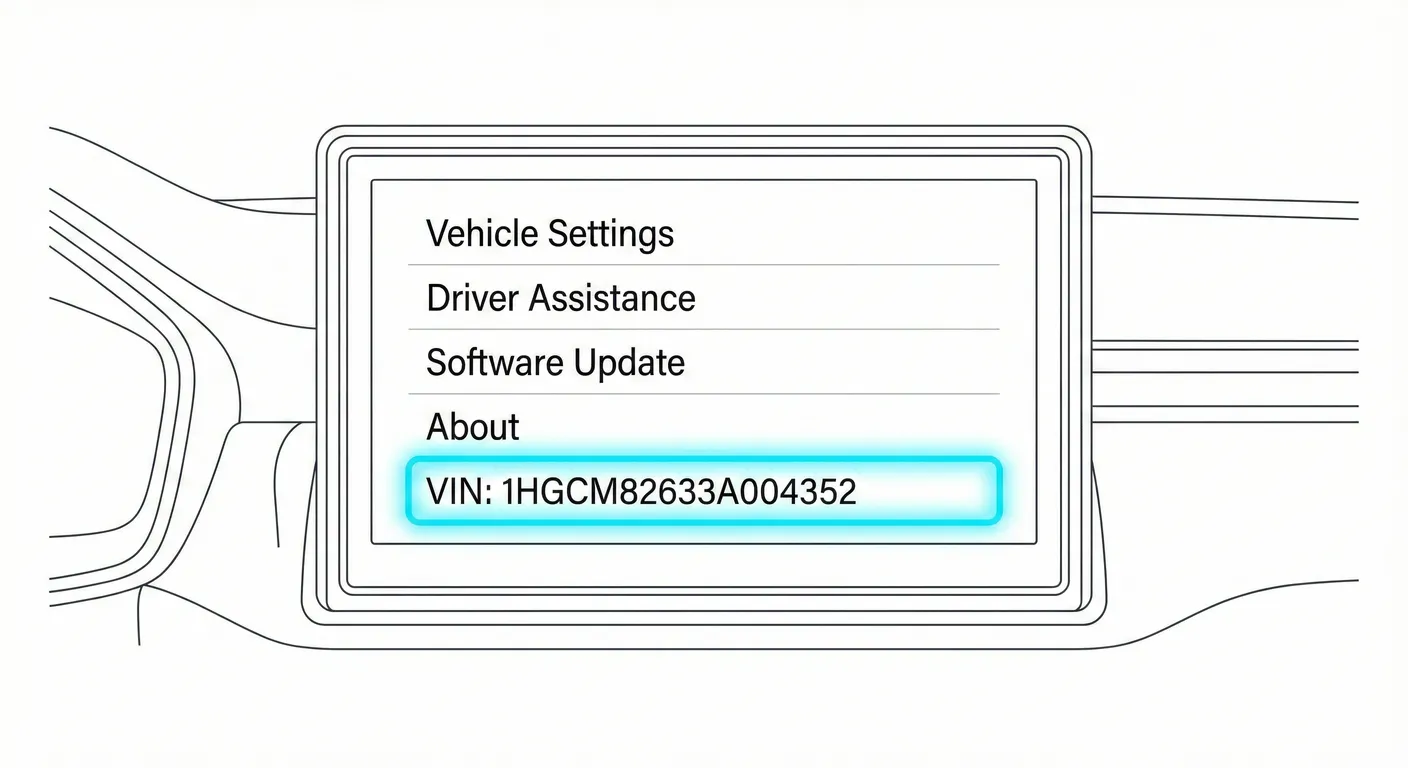
- Where to look: On the center screen, use a menu path similar to:
Information→Vehicle Status Monitor→Maintenance(exact wording varies by system/region). - Access: Medium difficulty. Ignition must be ON and menus vary; scanning screens can introduce flicker/moiré.
- Note: Treat this as verification only—it’s not as trustworthy as the physical label/stamp for inspections and paperwork.
- Tip: If the screen flickers in photos, pause and hold steady—then scan and confirm the VIN carefully to avoid a one-character mistake.
Common Problems & Troubleshooting
- Windshield glare/reflections: Move your body angle left/right and reduce distance to the glass; reflections from the dash can hide characters.
- Hidden floor stamp is hard to see: Lift the flap/cut-out fully, use a flashlight, and wipe dirt off the stamping before trying to read it.
- Door jamb sticker integrity: If the label is torn, repainted over, or missing, don’t rely on it alone—cross-check with the floor/chassis stamp.
Frequently Asked Questions
Where is the VIN on Mazda 3?
Start with the driver’s-side B-pillar/door jamb certification label (best target). You can also find a visible VIN on the driver’s-side lower windshield corner, and a stamped VIN under a flap in the right-side front footwell floor.
Which VIN location is the most important for Mazda 3?
For quick ID, the B-pillar/door-jamb label is the easiest to access and scan. For legal verification (especially if labels are missing or questionable), the stamped chassis VIN in the footwell floor is the most authoritative physical identifier.
Mazda 3 III (BM) [2013-2018]
Quick response
Quick Answer: The most reliable VIN location for the Mazda 3 (BM) is the B-pillar certification label (door jamb). It’s typically a white/silver sticker on the lower B-pillar when you open a front door. Expert tip: open the door fully and use a light to avoid shadows from the door frame.
This guide shows where to find the VIN/chassis number on the Mazda 3 III (BM) produced between 2013–2018, including the quick-to-scan plates and the hidden stamped chassis number.
Chassis Number Locations
1) Windshield (dashboard)
- Where to look: Stand outside the car and look through the lower corner of the windshield on the left side (driver side for LHD). The VIN plate sits under the glass, visible through a small cutout in the black frit/dot-matrix band.
- Access: Easy to reach but glare/reflections from glass can hide digits, especially in bright sun.
- Note: This is a standard “visible VIN” spot. If the plate area looks blank on your car, double-check the other locations below.
- Tip: If reflections keep washing out the characters, scan it directly with your phone using ScanVin.app at a slight angle so the OCR captures the VIN without transcription mistakes.
2) B-pillar certification label (door jamb)
- Where to look: Open a front door and inspect the lower B-pillar (the door jamb area between the front and rear doors). The VIN is printed on a certification/VIN sticker (high-contrast black text on white/silver).
- Access: Usually the easiest location—good lighting with the door open. Sticker can be scuffed from shoes, cargo, or repeated entry/exit.
- Note: Side can vary by region. On many LHD cars it’s on the left/driver B-pillar, but some markets place it on the right/passenger B-pillar—if you don’t see it immediately, check both sides.
- Tip: If shadows or faded print make it hard to read, use the free VIN reader on ScanVin.app with your flashlight to capture the full code cleanly.
3) Floor chassis stamp (under front seat, under carpet flap)
- Where to look: The VIN is stamped into the metal chassis cross-member under a front seat, hidden under a carpet flap:
- Slide the front right seat all the way back (commonly passenger side for LHD, but check the other front seat if you don’t find it).
- Find the pre-cut carpet flap in the floor.
- Lift the carpet flap.
- Flip open the hard plastic cover marked “FRAME NUMBER”.
- The VIN is stamped into the metal underneath.
- Access: More work. It’s dark under the seat, and stamped characters can be low-contrast against the metal (easy to miss).
- Note: This stamped VIN is a strong “verification” point when you’re checking if the car matches the paperwork.
- Tip: Because it’s dark and the stamp can be faint, capture it with ScanVin.app + Flashlight OCR so you don’t have to squint or guess characters in an awkward position.
4) Etched windows (security marking)
- Where to look: Look for VIN/security etching on side windows and rear glass—it’s lightly etched into the glass.
- Access: Visible but hard to read because it’s transparent-on-transparent and your camera may struggle to focus.
- Note: Useful as a supporting check, not the primary VIN plate.
- Tip: If your eyes can see it but your camera won’t lock focus, try scanning with ScanVin.app while bracing the phone close to the glass to stabilize the shot.
5) Engine bay (firewall/cowl) — reference only 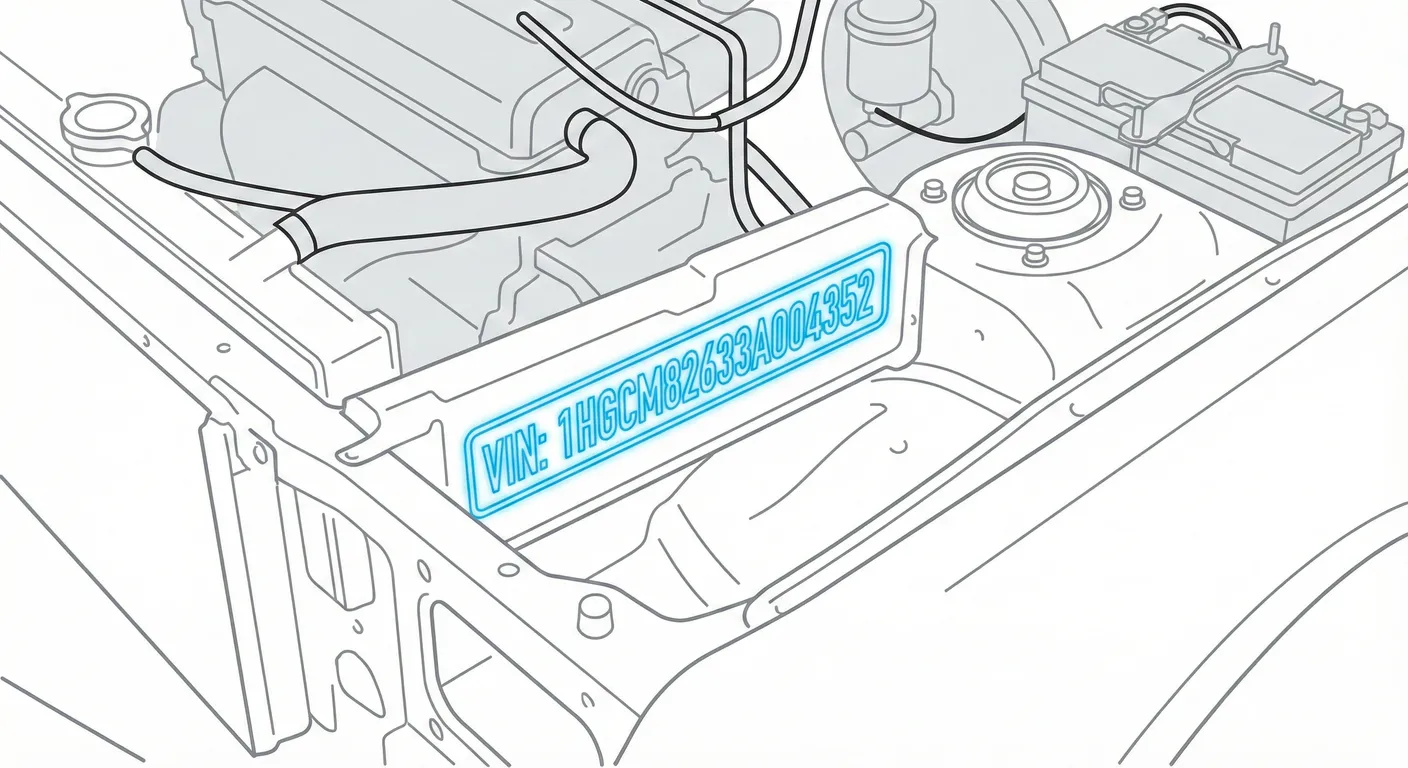
- Where to look: Some vehicles have a VIN stamp/plate on the firewall/cowl area under the hood.
- Access: Often dirty/obstructed by hoses and covers, and not the easiest angle for a phone.
- Note: Treat this as a backup check if your windshield label or door sticker is missing/unreadable.
- Tip: If grime or low contrast makes it unreadable, use ScanVin.app to scan and enhance the characters instead of trying to copy it by hand.
Video Guide
Video Tutorial: VIN Locations - Mazda 3 (2014-2018)
- Clear walk-through of the three main VIN points (windshield, door jamb label, and the hidden floor/chassis stamp under the plastic “FRAME NUMBER” cover).
Video Tutorial: Where is the VIN number of my MAZDA 3 III ( 2013 – 2018 ) | All Possible VIN Number Locations
- Shows VIN/markings on a hatchback, including window etching, the door sticker, and the under-seat floor stamp.
Common Problems & Troubleshooting
- Windshield VIN has glare: Shade the area with your body and tilt your phone slightly; glare can wipe out a few digits even when the plate is present.
- Floor stamp is hard to see: Slide the seat fully back, lift the carpet flap, and use a flashlight—stamped metal can be low-contrast and easy to misread.
- Door jamb sticker concerns: If the sticker looks damaged, repainted over, or replaced, verify the VIN matches the stamped floor VIN and the vehicle documents before you buy.
Frequently Asked Questions
Where is the VIN on Mazda 3?
Check the B-pillar door jamb certification label first (open a front door and inspect the lower B-pillar). Then check the VIN plate at the lower left corner of the windshield (visible from outside).
Which VIN location is the most important for Mazda 3?
For day-to-day checks, the windshield VIN and the B-pillar label are the fastest. For verification/anti-tamper, the stamped chassis VIN under the front seat (under the carpet flap and plastic cover) is the strongest cross-check.
Mazda 3 II (BL) [2009-2010]
Quick response
Quick Answer: The most reliable VIN location for the Mazda 3 is the driver’s side B-pillar / door jamb label. It’s typically located on the B-pillar below the door latch striker, visible when you open the driver’s door. Expert tip: if the sticker is faded or the plate is reflective, scan it instead of typing it.
This guide covers the VIN (and chassis number locations used in some markets) for the Mazda 3 II (BL) produced between 2009–2010. Use the locations below to quickly verify the car’s identity during buying, registration, or parts ordering.
Chassis Number Locations
Driver’s side B-pillar / door jamb label
- Where to look: Open the driver’s door and look at the B-pillar area below the door latch striker.
On many LHD North American cars it’s a white certification sticker; on some RHD/ROW cars it can be a black riveted plate. - Access: Usually easy to access. The white sticker can fade/peel, and the black plate can be reflective, but both are on a flat surface.
- Note: LHD guide priority: this is the most common everyday VIN lookup point. RHD models may show a riveted plate rather than a sticker.
- Tip: If the label is faded or glossy, scan the VIN directly with your phone so you don’t misread characters like 8/B or 0/O.
Engine bay firewall / cowl panel (stamped chassis number)
- Where to look: Open the hood and check the firewall/cowl panel area, behind the engine, just below the windshield wiper cowl trim, near the center-right when viewed from the front. The number is stamped into the metal (not a sticker).
- Access: Harder than the door label. This area is commonly shadowed, and stamping can be covered with dust/grime.
- Note: In many non-US markets this stamped chassis number is a primary identifier for registration checks.
- Tip: Because it’s dark and stamped into metal, use a light and capture it with the free VIN reader to pick up the stamped relief without you crouching and guessing.
Dashboard VIN plate (through the windshield)
- Where to look: Stand outside the car and look through the lower corner of the windshield on the left side (driver’s side for LHD). The VIN is on a metal plate riveted to the dashboard and visible through the glass.
- Access: Quick to find, but glare/reflections (sun/overhead lights) and windshield scratches can wash out characters.
- Note: This is a standard consumer-facing VIN position and is commonly used for quick checks.
- Tip: If glare is killing readability, change your viewing angle and scan it instantly with ScanVin.app to avoid transcription mistakes.
Floor panel beside the front seat (under a plastic flap)
- Where to look: Check the front footwell floor for a small plastic flap/cover that lifts to reveal a stamped identifier on the floor panel. It’s commonly on the passenger side for LHD vehicles, but check the driver side footwell if not found.
- Access: Requires you to lift a flap/trim and it’s usually dark down there.
- Note: This location is market-dependent and may not be present on every BL.
- Tip: If lighting is poor, use your phone flash and scan it with the VIN OCR tool so you don’t have to contort and manually write it down.
Engine block number (stamped on the block)
- Where to look: On a machined flat area of the engine block, typically down the side of the block and not easily visible from above without angling the camera past hoses/wiring.
- Access: Very difficult—often dirty/greasy, deep in the bay, and awkward to photograph.
- Note: This is typically an engine number, not the easiest “VIN check” point, but it can help confirm originality if you’re doing deeper verification.
- Tip: When it’s cramped and greasy, scan it instead of hand-copying—zoom + AI contrast helps when your eyes can’t line up with the stamping.
Video Guide
Video Tutorial: VIN Locations - Mazda 3 (2010-2013) - YouTube
- Clear walkthrough showing the windshield VIN plate and the driver-side B-pillar certification label on an LHD Mazda 3.
Common Problems & Troubleshooting
- Windshield glare: If the VIN plate washes out in sunlight or under shop lights, change angle, shade the plate with your body, and scan instead of typing.
- Stamped numbers hard to read (engine bay/firewall): Dust + shadows hide the stamping—wipe the area clean and use strong lighting for a clean capture.
- Sticker validity warning: A door-jamb sticker can be replaced or damaged—for serious verification, compare multiple VIN/chassis locations and ensure they match paperwork.
Frequently Asked Questions
Where is the VIN on Mazda 3?
Check the driver’s side B-pillar/door jamb label below the door latch striker first. As a second common spot, look through the lower driver-side windshield corner at the riveted dashboard VIN plate.
Which VIN location is the most important for Mazda 3?
For day-to-day verification, the door-jamb VIN label and the dashboard VIN plate are the most commonly referenced. For deeper identity checks (especially outside North America), the stamped chassis number in the engine bay/firewall area is a strong physical identifier because it’s stamped into the body.
Mazda 3 Mazda 3 I (BK) [2004-2008]
Quick response
Quick Answer: The most reliable VIN location for the Mazda 3 is the B-pillar VIN label. It’s typically located on the door jamb (center pillar where the door latches) and is usually clean and easy to read—watch out for glare from the glossy sticker.
This guide shows where to find the VIN (and other identifying numbers) on the Mazda 3 I (BK) produced between 2004–2008, using the quickest checks first—like a working mechanic would.
Chassis Number Locations
B-Pillar (VIN Label)
- Where to look: Open the front door and look on the B-pillar/door jamb (the center pillar where the door latches) for a black sticker with white text.
- Access: Easy—no tools needed. The label is usually protected and readable, but the sticker surface can be glossy.
- Note: For LHD (US/EU) cars, check the driver-side door jamb first; on RHD cars it’s commonly on the opposite side.
- Tip: If the label is reflecting light, slightly angle your phone and scan it directly with ScanVin.app to capture the VIN cleanly without misreading characters.
Floor (Under Seat / Carpet Flap)
- Where to look: Check the front footwell floor, typically under a cut-out flap in the carpet (sometimes under a small plastic cover) near the front seat slide rail.
- Access: Moderate—may require you to slide the seat back, lift the carpet flap, and wipe dust off the cover/metal area.
- Note: This location is commonly on the passenger side for LHD vehicles, but check the driver side footwell if not found.
- Tip: This area is often dark under the dash and seat—use your phone light and use the flashlight + OCR scan in ScanVin.app so you don’t have to read it upside down.
Firewall / Bulkhead (Chassis Number)
- Where to look: In the engine bay, find the metal firewall/bulkhead (wall between engine and cabin). Look high up, just below the rubber weather strip at the top of the cowl, slightly offset to the left when facing the engine; the VIN is stamped into the metal.
- Access: Medium—often shadowed by the cowl overhang. Hoses/cabling may run below it and dirt tends to collect there.
- Note: Use vehicle-orientation terms carefully: “left/right” refers to the car’s left/right in the direction of travel.
- Tip: If the stamping is hard to see due to shadow and body-color paint, scan it with your phone using ScanVin.app so the app can pick up the embossed characters without you guessing.
Engine Number Location (Not the VIN)
Engine Block (Engine Number)
- Where to look: On the engine block, stamped on a machined flat surface on the front/right side (when facing the engine). You may need to aim down past radiator/coolant hoses.
- Access: Difficult—tight space, often grimy, and you don’t want to lean into a hot engine bay.
- Note: The engine number is useful for paperwork/inspection in some regions, but it’s not a substitute for the chassis VIN.
- Tip: If it’s greasy and hard to reach, use ScanVin.app to capture it hands-free instead of trying to write it down while wedged over the engine.
Common Problems & Troubleshooting
- Stamped VIN hard to read in the engine bay: Dirt builds up near the cowl/firewall—scrub lightly with a nylon brush and wipe, then re-check with a flashlight.
- Engine number hidden by hoses and grime: Let the engine cool, then wipe the flat stamped pad with degreaser on a rag (don’t spray directly onto sensors/connectors).
- Sticker VIN vs stamped VIN mismatch: Door-jamb labels can be replaced—when buying a car, always confirm the stamped VIN matches the label VIN and the documents.
Frequently Asked Questions
Where is the VIN on Mazda 3?
Start with the B-pillar VIN label on the door jamb (center pillar). Also check for a stamped VIN in the front footwell floor under a carpet flap (commonly passenger side on LHD, but verify both sides if needed).
Which VIN location is the most important for Mazda 3?
The most important VIN is the one stamped into the vehicle body/chassis (tamper-resistant). The door-jamb sticker is convenient for quick checks, but the stamped VIN is the one you should trust for identity verification.
Don't see your generation?
Try scanning simple VIN code. Our scanner will automatically identify the Make, Model and Generation.
Scan VINNote on Data Sources
Information about VIN location in this model comes from aggregation of official technical documentation (OEM) and spare parts catalogs. Despite careful algorithmic verification, the data is for reference purposes only. Final vehicle identification should always be confirmed by an authorized technician.
See how we verify data and build our database →