
Where is the VIN in the Renault Captur?
Select your car's generation to see the exact VIN number locations
VIN Location Overview for Renault Captur
2 generationsSelect the generation of your car to see the exact VIN number locations
| Generation & Years | Typical VIN Locations | Details | |
|---|---|---|---|
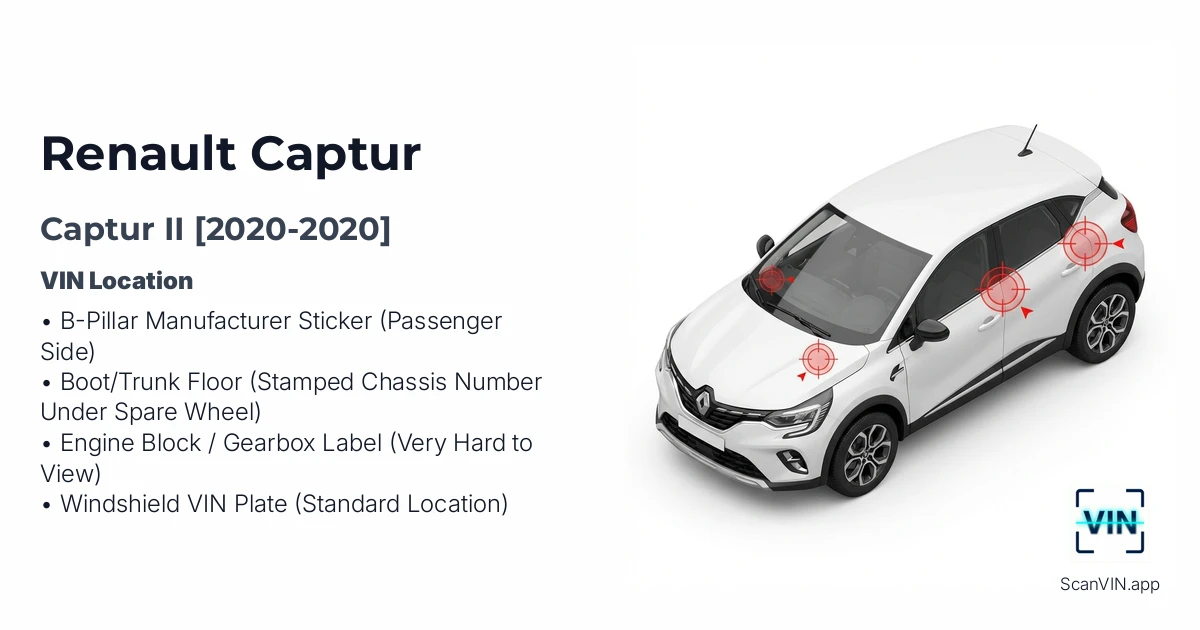 | II 2020 2020 | B-Pillar Manufacturer Sticker (Passenger Side) Boot/Trunk Floor (Stamped Chassis Number Under Spare Wheel) Engine Block / Gearbox Label (Very Hard to View)
+1 | View details |
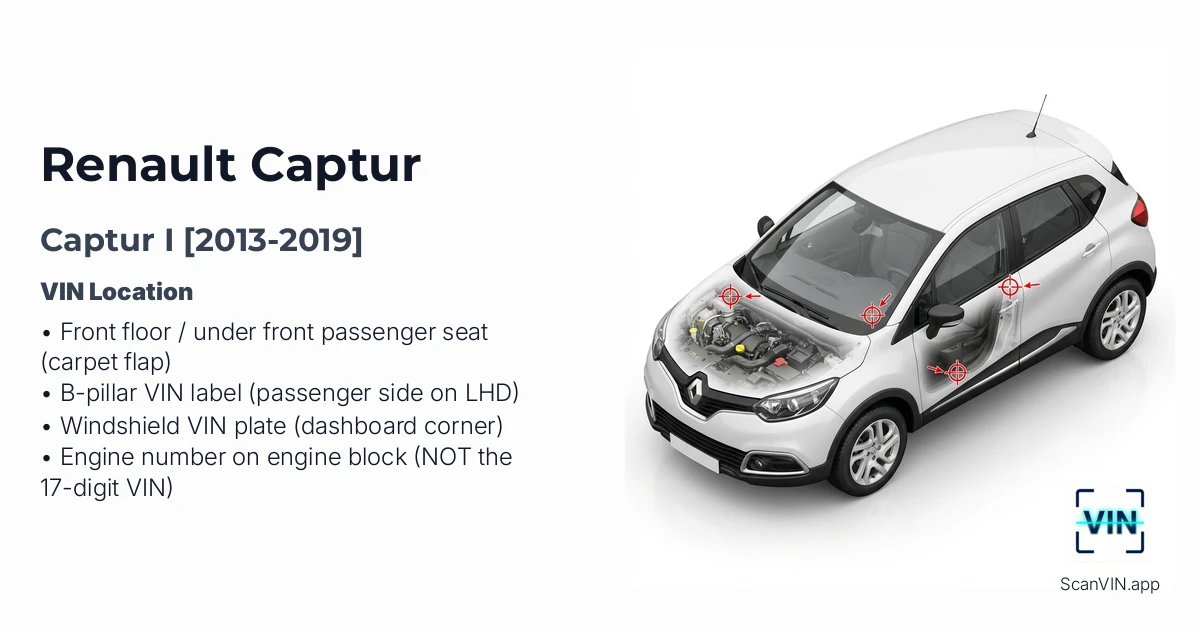 | I 2013 2019 | Front floor / under front passenger seat (carpet flap) B-pillar VIN label (passenger side on LHD) Windshield VIN plate (dashboard corner)
+1 | View details |
Renault Captur Captur II [2020-2020]
Quick response
Quick Answer: The most reliable VIN location for the Renault Captur II is the manufacturer label on the lower B-pillar (passenger-side door jamb). It’s on a white sticker at the base of the center door post—open the front passenger door and look low on the pillar. It’s easy to access and usually scans cleanly because it’s high-contrast print.
This guide shows you where to find the VIN (Vehicle Identification Number) on the Renault Captur II produced between 2020 and 2020, including the quickest sticker location and the harder stamped chassis number in the boot.
Chassis Number Locations
B-Pillar Manufacturer Sticker (Passenger Side) 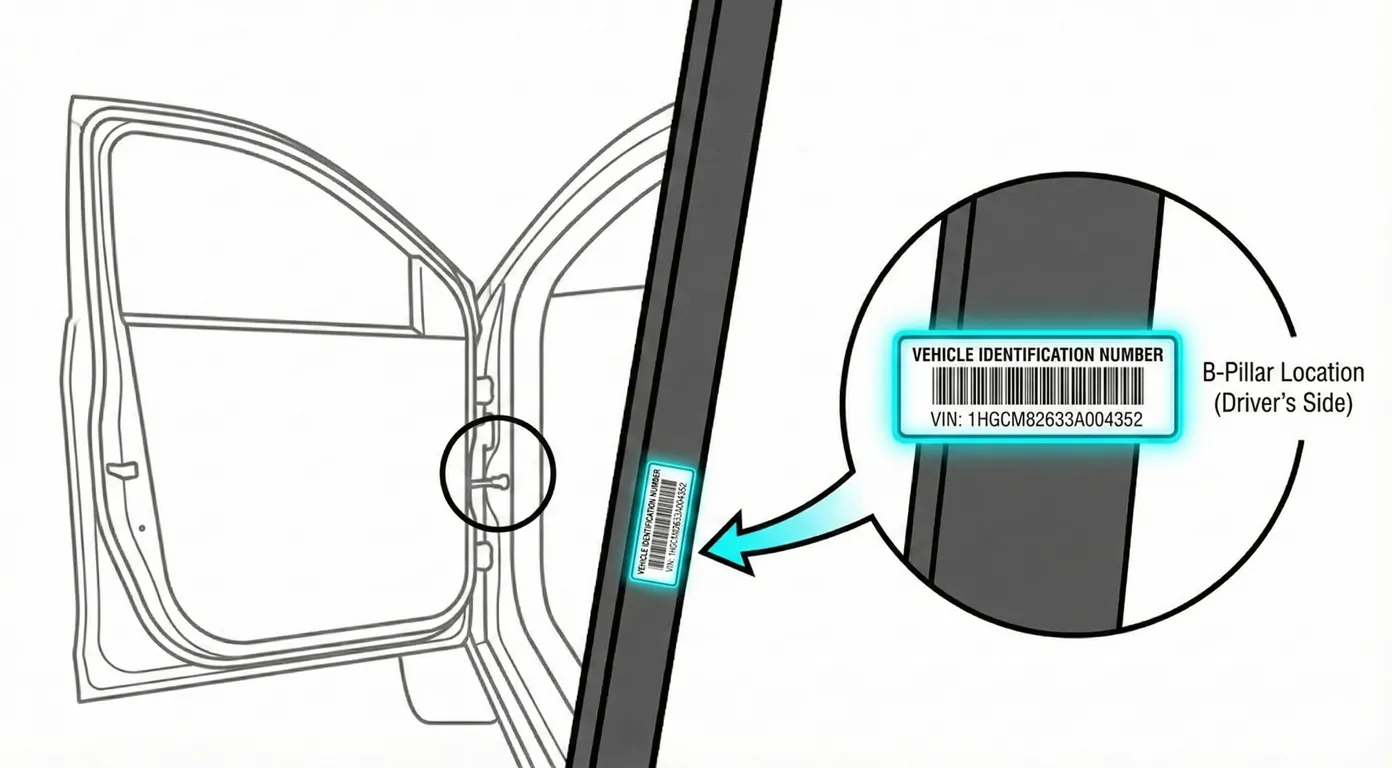
- Where to look: Open the front passenger door and look at the lower section of the B-pillar (the vertical post between the front and rear doors). You’ll see a white manufacturer label with the VIN plus weights/paint info printed on it.
- Access: Very easy—no tools needed, usually clean, and the black-on-white text is clear.
- Note: The video shows an RHD car where this sticker appears on the left side; for LHD (EU/US) Captur II, it’s typically on the right-side B-pillar (still the passenger side).
- Tip: Because it’s a vertical sticker that’s easy to light up, you can scan it directly with your phone to avoid mistyping long VIN characters.
Boot/Trunk Floor (Stamped Chassis Number Under Spare Wheel) 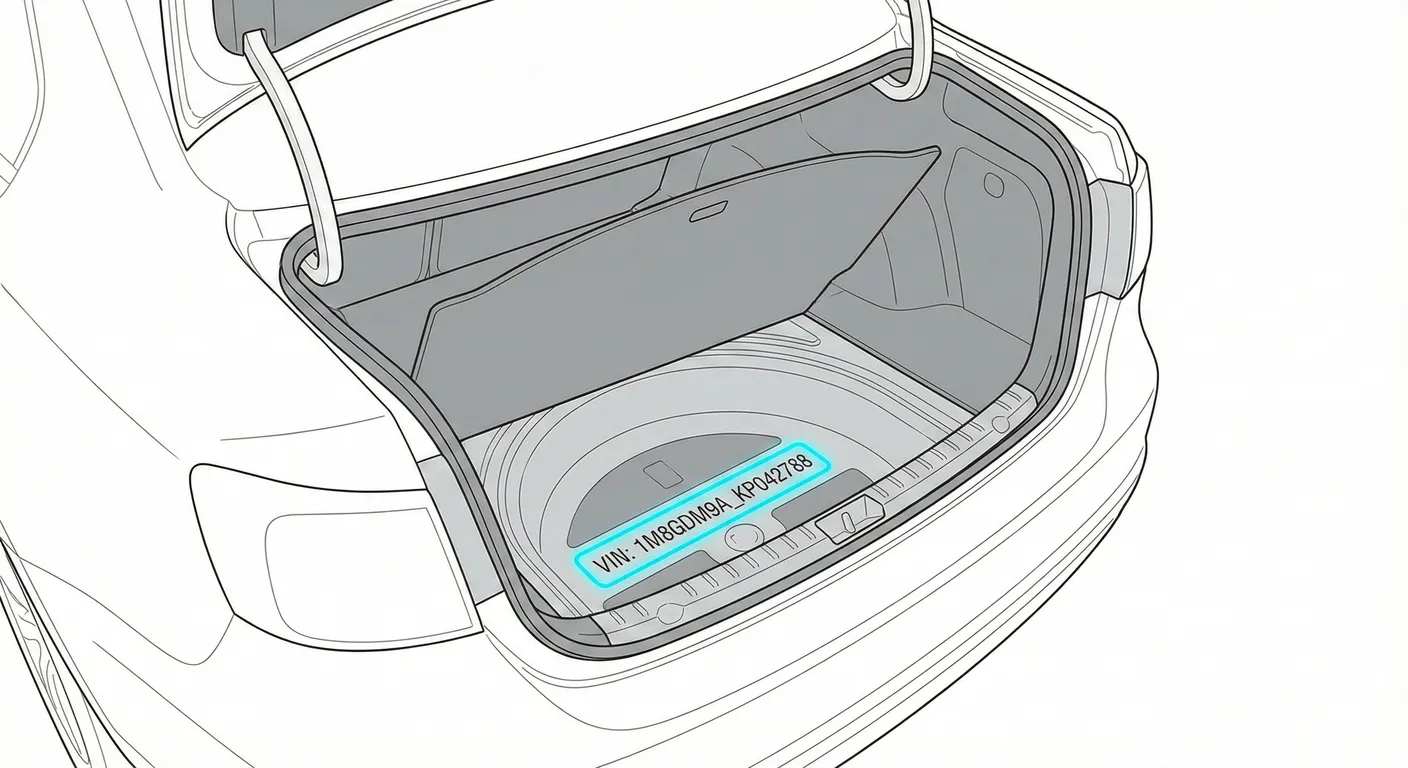
- Where to look: Open the tailgate, then:
- Lift the false boot floor panel
- Remove the carpet/felt cover over the spare wheel well
- Unscrew the plastic nut holding the jack/tool kit
- Lift out the foam organizer
- Remove the spare wheel
- Peel back/lift the felt lining under the spare wheel
- Find the VIN stamped into the metal floor pan, slightly off-center in the well
- Access: High difficulty—requires removing the boot floor layers and the spare wheel; the stamping is often low-contrast (same color as the body metal) and the well is dark.
- Note: This is a good “backup” VIN when the door sticker is missing/damaged, but it’s not a quick check.
- Tip: The spare wheel well is shadowy and the stamp can be faint—use Flashlight + OCR and scan the stamping with the free VIN reader so you don’t have to crouch and hand-copy characters.
Engine Block / Gearbox Label (Very Hard to View) 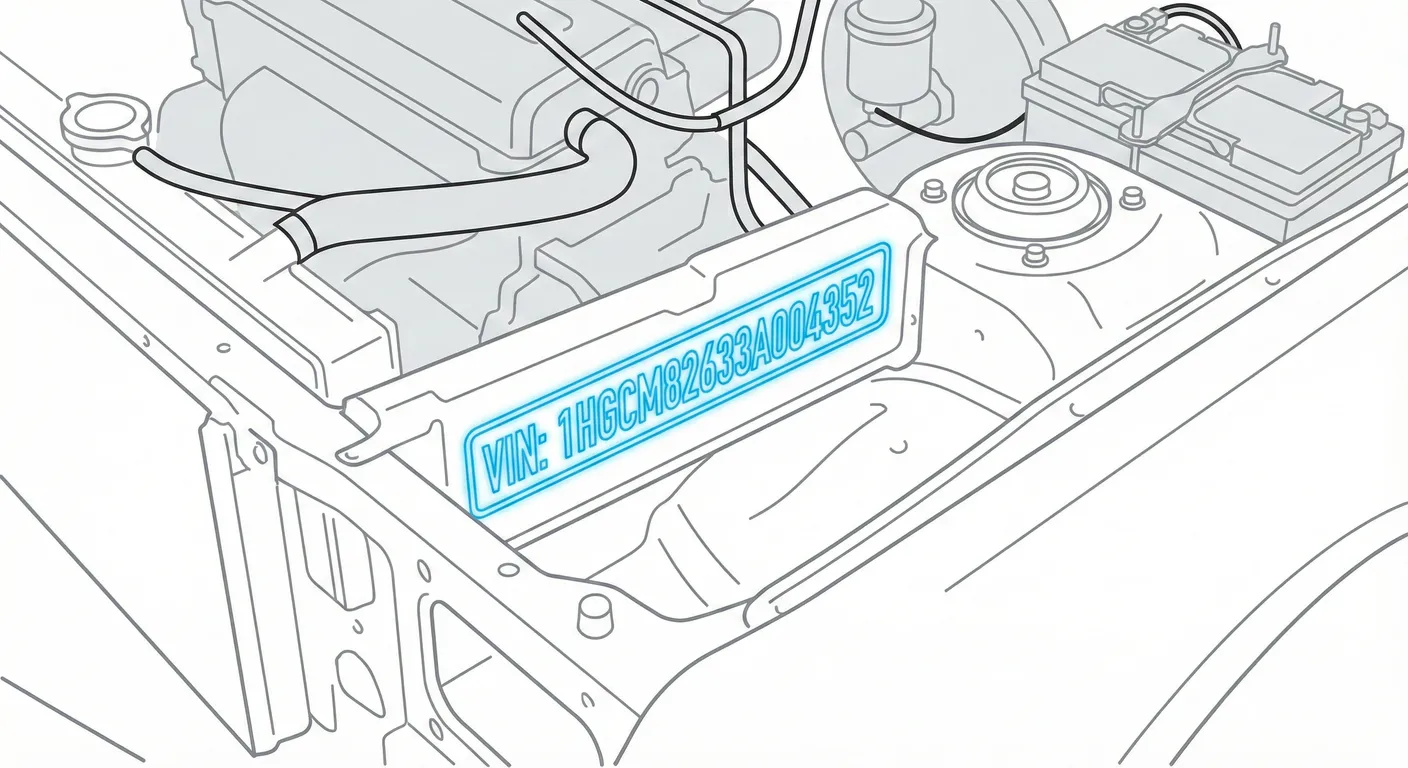
- Where to look: Open the hood. Near the battery area (right side when facing the engine), look down into the tight gap by the air intake hose / ECU area. There may be a dot-peen/laser-etched code and/or a QR/Data Matrix sticker on a metal surface.
- Access: Extreme difficulty—tight angles, poor lighting deep in the bay, and dirt/grease can hide characters. Filming/reading it is awkward without a special angle.
- Note: What you see here may be an engine/gearbox serial rather than the full VIN—use the B-pillar label or boot floor stamp as your primary VIN sources.
- Tip: If the code is greasy, etched, or partly obscured, use High Contrast AI Mode and capture it with your phone instead of trying to read it while leaning over the engine.
Windshield VIN Plate (Standard Location) 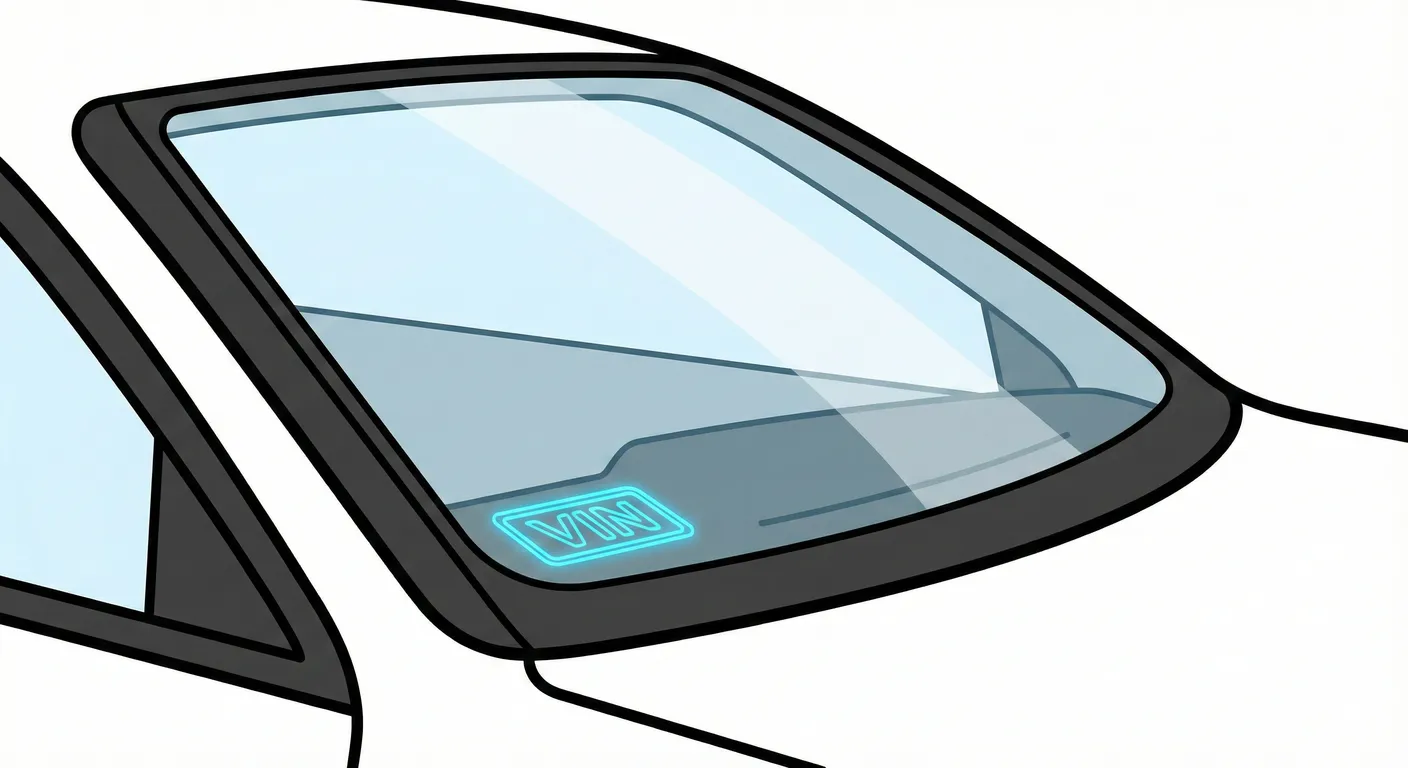
- Where to look: Check the lower corner of the windshield, readable from outside the vehicle (look through the glass at the base of the dash area).
- Access: Easy—no tools—but glare/reflections can make it annoying to read.
- Note: If you don’t see it immediately, change your viewing angle or shade the glass with your body.
- Tip: Reflections can scramble characters—scan the windshield VIN instantly so you don’t mix up “8/B”, “5/S”, or “0/O”.
Video Guide
Video Tutorial: Renault Captur (2020) Chassis Vin Number Location pr/bpt
- Quick walkaround showing the B-pillar label location—the easiest VIN to scan.
Video Tutorial: RENAULT CAPTURE NUMBER ENGINE & CHASSIS LOCATION
- Shows the stamped chassis number under the spare wheel (useful when the sticker is missing), then attempts the hard-to-see engine bay code.
Common Problems & Troubleshooting
- Boot stamp is hard to see: The stamped VIN under the spare wheel is often dark and low-contrast—use a flashlight, wipe the metal, and scan from multiple angles.
- Engine bay code unreadable: Tight access + grime makes the engine/gearbox marking hard to confirm—clean gently and don’t rely on it as your main VIN source.
- Sticker vs. stamp mismatch: Door-jamb stickers can be replaced; always cross-check the sticker VIN against the stamped chassis VIN before buying.
Frequently Asked Questions
Where is the VIN on Renault Captur?
Start with the manufacturer VIN sticker on the lower B-pillar (front passenger door jamb). If you need the stamped chassis VIN, check under the spare wheel in the boot floor.
Which VIN location is the most important for Renault Captur?
The stamped chassis VIN in the body (boot floor under the spare wheel) is the hardest to tamper with, so it’s the most authoritative for identity checks. The B-pillar sticker is the fastest for day-to-day reference and scanning.
Renault Captur Captur I [2013-2019]
Quick response
Quick Answer: The most reliable VIN location for the Renault Captur I is the VIN stamped into the floor cross-member under the front passenger seat (under a pre-cut carpet flap). It’s typically on the front footwell floor area (commonly passenger side on LHD cars)—bring a flashlight because it’s dark under the seat.
This guide covers the VIN (Vehicle Identification Number) locations on the Renault Captur I, produced between 2013 and 2019, so you can quickly match paperwork to the car before buying, selling, or inspecting.
Chassis Number Locations
Front floor / under front passenger seat (carpet flap) 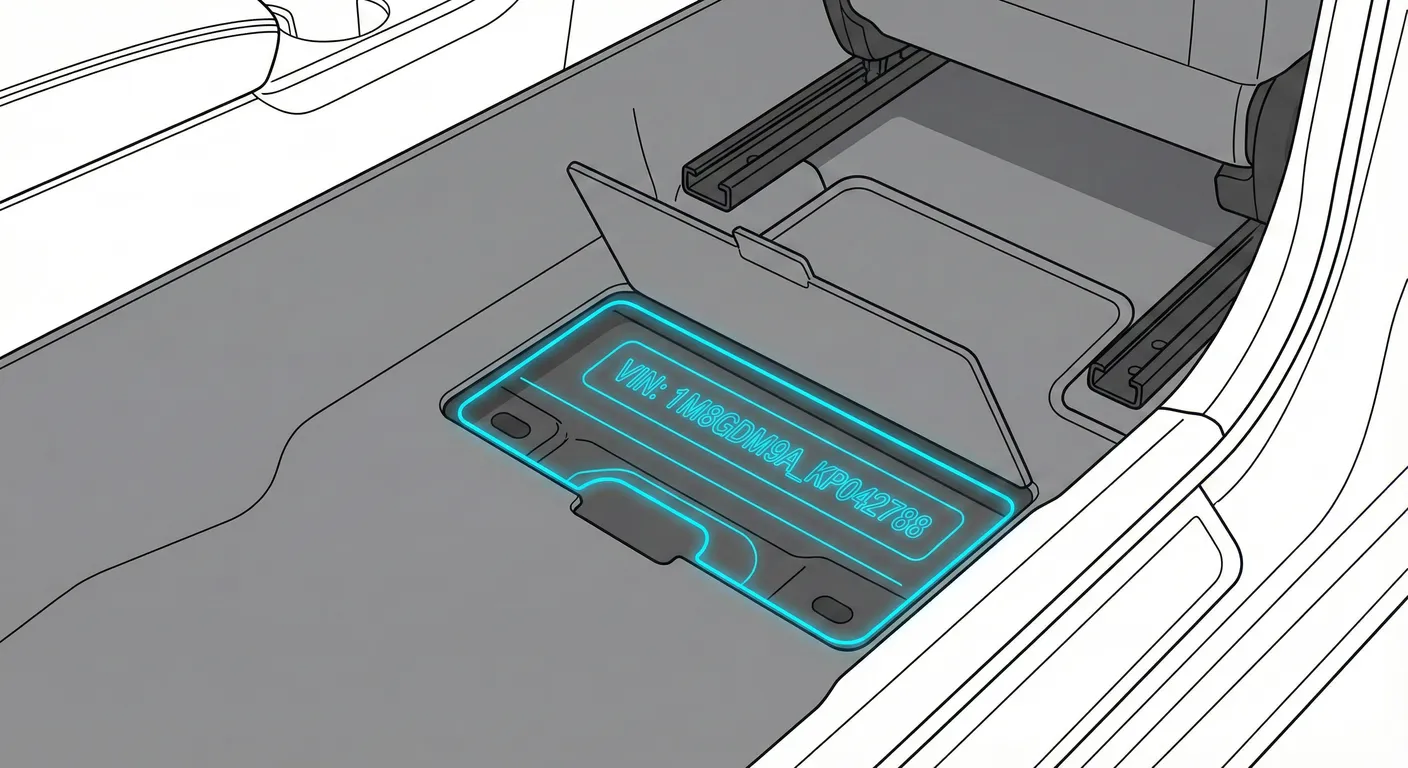
- Where to look: Slide the front passenger seat all the way back, then locate the pre-cut flap in the carpet under/near the seat rails. Lift the flap to reveal the VIN stamped into the chassis/floor cross-member.
- Access: Medium. It’s cramped and shadowy under the seat; the flap can be hard to spot if mats are covering it—use a flashlight.
- Note: For LHD Captur, this is commonly on the right side (passenger side). If you don’t find it there, check the driver-side footwell as some markets can be mirrored.
- Tip: Because it’s dark under the seat, use Flashlight + OCR to scan the VIN directly with your phone instead of squinting and copying digits.
B-pillar VIN label (passenger side on LHD)
- Where to look: Open the front passenger door and look on the lower B-pillar (the post between the front and rear doors). You’ll see a VIN/vehicle data sticker with the VIN plus paint/weight info.
- Access: Low. No tools—just open the door and wipe dust off the label if needed.
- Note: On LHD vehicles this is typically on the right-side B-pillar (passenger side). On RHD cars it’s usually mirrored.
- Tip: Labels are usually high-contrast and easy, so use the free VIN reader to capture it cleanly and avoid mixing up similar characters like S/5 or B/8.
Windshield VIN plate (dashboard corner)
- Where to look: Check the bottom corner of the windshield, readable from outside (commonly the driver-side lower corner on many cars). Look for the VIN through the glass.
- Access: Low. Easiest “walk-up” check—no panels to lift.
- Note: If glare blocks it, change your viewing angle or shade the glass with your hand.
- Tip: Windshield glass causes reflections—capture it with your phone so you don’t mistype the VIN when glare is bad.
Engine number on engine block (NOT the 17-digit VIN)
- Where to look: Low on the engine, near the gearbox bell housing on a flat machined surface (often confused with the VIN).
- Access: Very High. Tight space, hoses/pipes in the way, and you’ll need a strong light.
- Note: This is the engine number, not the body VIN. Don’t use it as the vehicle VIN for registration/history checks.
- Tip: If you’re checking it for matching numbers, the area is hard to see—scan it instead of writing it down in an awkward position.
Video Guide
Video Tutorial: Location of the Renault Captur engine and chassis number tip
- Shows the VIN under the passenger-seat carpet flap (floor stamp) and also points out the engine number location in the engine bay.
Video Tutorial: Renault Captur vin number location - YouTube
- Quick clip showing the VIN/data sticker on the B-pillar with the door open.
Common Problems & Troubleshooting
- Can’t find the floor VIN: Floor mats and seat position hide the carpet flap—slide the seat fully back/forward, feel for the pre-cut flap, then lift it with your fingers.
- Too dark to read under the seat: Use a bright flashlight and clean the stamping lightly; shadows under the seat make characters look “broken.”
- Sticker doesn’t prove the chassis is original: B-pillar labels can be missing, repainted over, or replaced—for inspections, prioritize the floor-stamped VIN and confirm it matches the documents.
Frequently Asked Questions
Where is the VIN on Renault Captur?
Check the VIN stamped into the floor under the front passenger seat (lift the pre-cut carpet flap). Also check the VIN/vehicle data sticker on the lower B-pillar with the front passenger door open.
Which VIN location is the most important for Renault Captur?
The most important VIN is the one physically stamped into the chassis (the floor stamp under the front passenger seat). It’s the hardest to tamper with and is the reference VIN for inspections.
Don't see your generation?
Try scanning simple VIN code. Our scanner will automatically identify the Make, Model and Generation.
Scan VINNote on Data Sources
Information about VIN location in this model comes from aggregation of official technical documentation (OEM) and spare parts catalogs. Despite careful algorithmic verification, the data is for reference purposes only. Final vehicle identification should always be confirmed by an authorized technician.
See how we verify data and build our database →