
Where is the VIN in the Renault Master?
Select your car's generation to see the exact VIN number locations
VIN Location Overview for Renault Master
2 generationsSelect the generation of your car to see the exact VIN number locations
| Generation & Years | Typical VIN Locations | Details | |
|---|---|---|---|
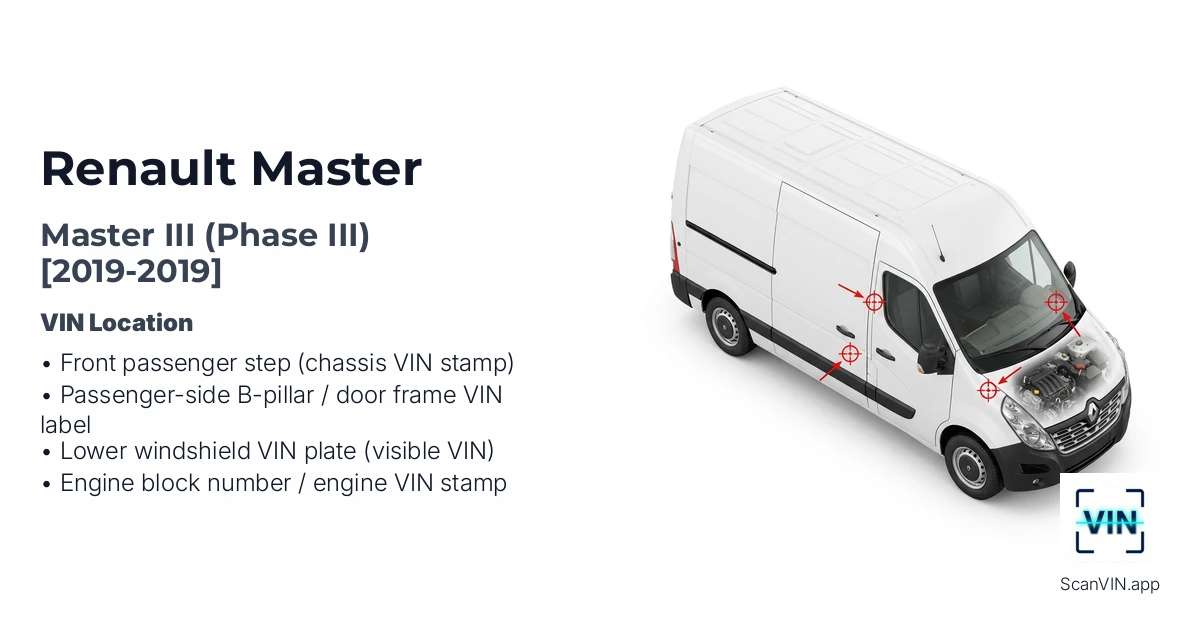 | III Phase III 2019 2019 | Front passenger step (chassis VIN stamp) Passenger-side B-pillar / door frame VIN label Lower windshield VIN plate (visible VIN)
+1 | View details |
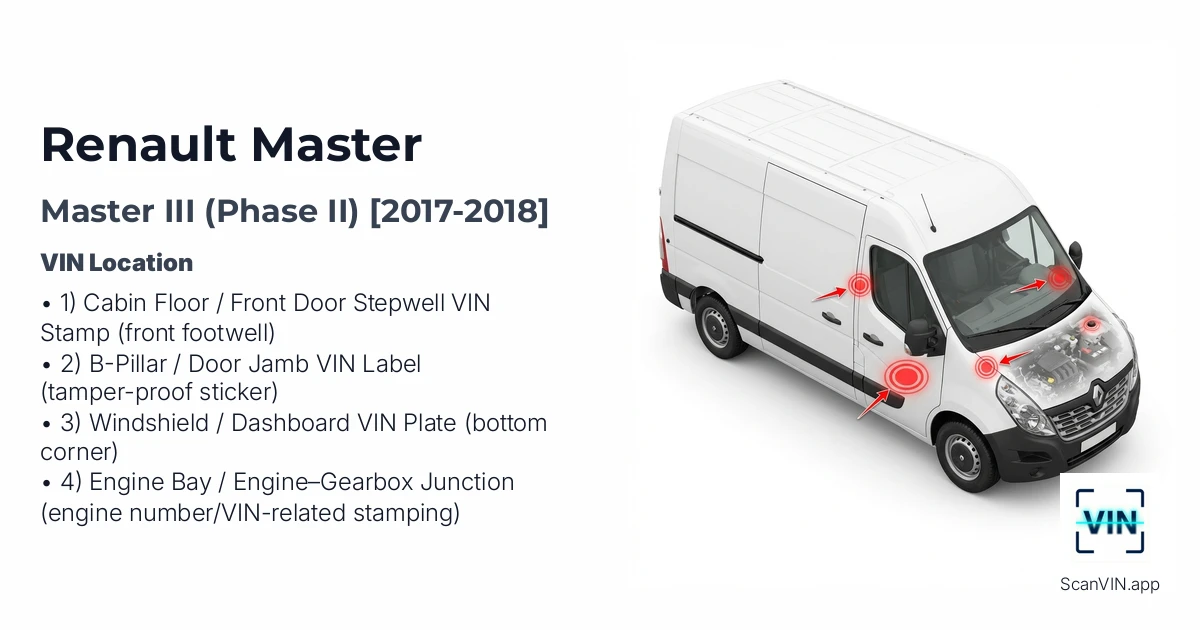 | III Phase II 2017 2018 | 1) Cabin Floor / Front Door Stepwell VIN Stamp (front footwell) 2) B-Pillar / Door Jamb VIN Label (tamper-proof sticker) 3) Windshield / Dashboard VIN Plate (bottom corner)
+1 | View details |
Renault Master Master III (Phase III) [2019-2019]
Quick response
Quick Answer: The most reliable VIN location for the Renault Master III (Phase III) is the front passenger door step (chassis VIN stamp under a plastic flap). It is typically located under a small rectangular cover in the plastic step trim. Use a flashlight and clean the stamp—this area is low, shadowed, and often packed with dirt.
This guide shows where to find the VIN (and other identifying numbers) on the Renault Master III (Phase III) produced between 2019–2019, using the most common factory stamp and label locations.
Chassis Number Locations
Front passenger step (chassis VIN stamp) 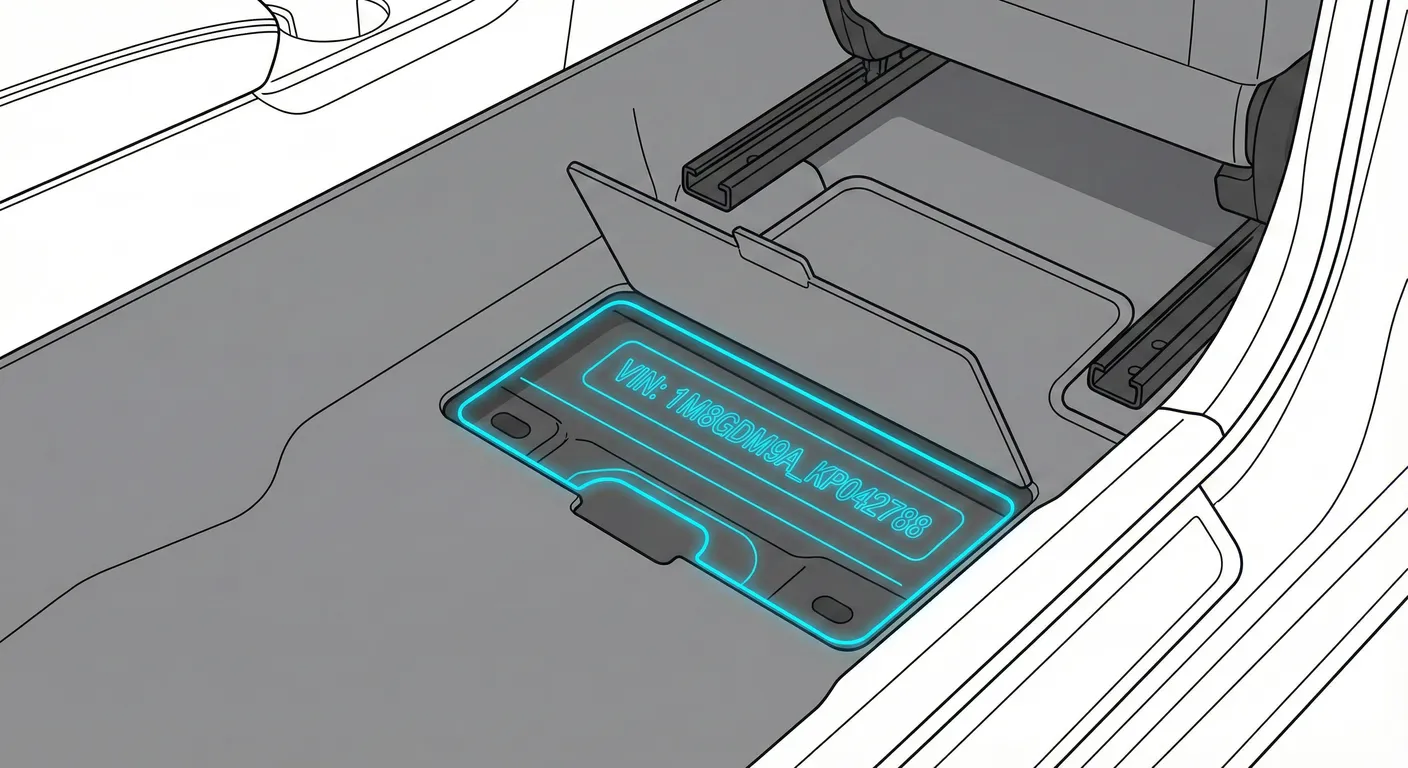
- Where to look: Open the front passenger door. On the floor step trim (the area you step on to get in), locate the rectangular plastic flap/cover integrated into the trim. Pry/lift the flap, and you’ll see the VIN stamped into the metal chassis underneath.
- Access: This spot is low and shadowed, and the stamped characters often fill with mud/grit—you may need to brush, wipe, or scrub the stamp before it becomes readable.
- Note: The floor VIN is on the passenger side (it mirrors between LHD and RHD markets). If you can’t find it there, check the opposite footwell as a backup.
- Tip: If the stamp is dark or packed with dirt, use your phone light and scan it directly with the flashlight + OCR tools so you don’t misread characters like B/8, S/5, or Z/2.
Passenger-side B-pillar / door frame VIN label 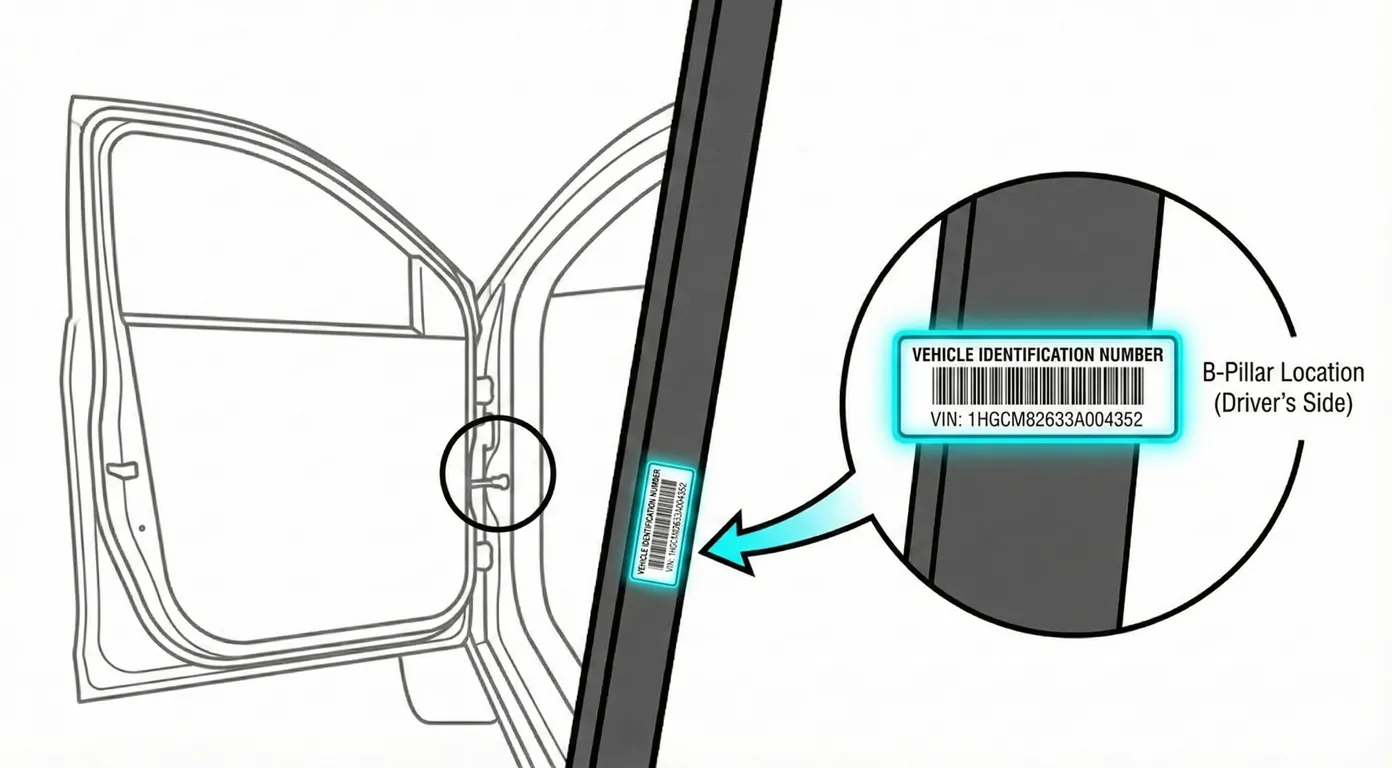
- Where to look: Open the front passenger door and check the B-pillar/door jamb area. Look below the striker plate for the manufacturer data sticker (VIN + weight ratings).
- Access: Usually easy and clean—it’s a printed label with good contrast.
- Note: This is one of the quickest places to confirm the VIN for paperwork and registration checks.
- Tip: For fast, error-free capture, use the free VIN reader to scan the sticker in one shot instead of typing 17 characters by hand.
Lower windshield VIN plate (visible VIN) 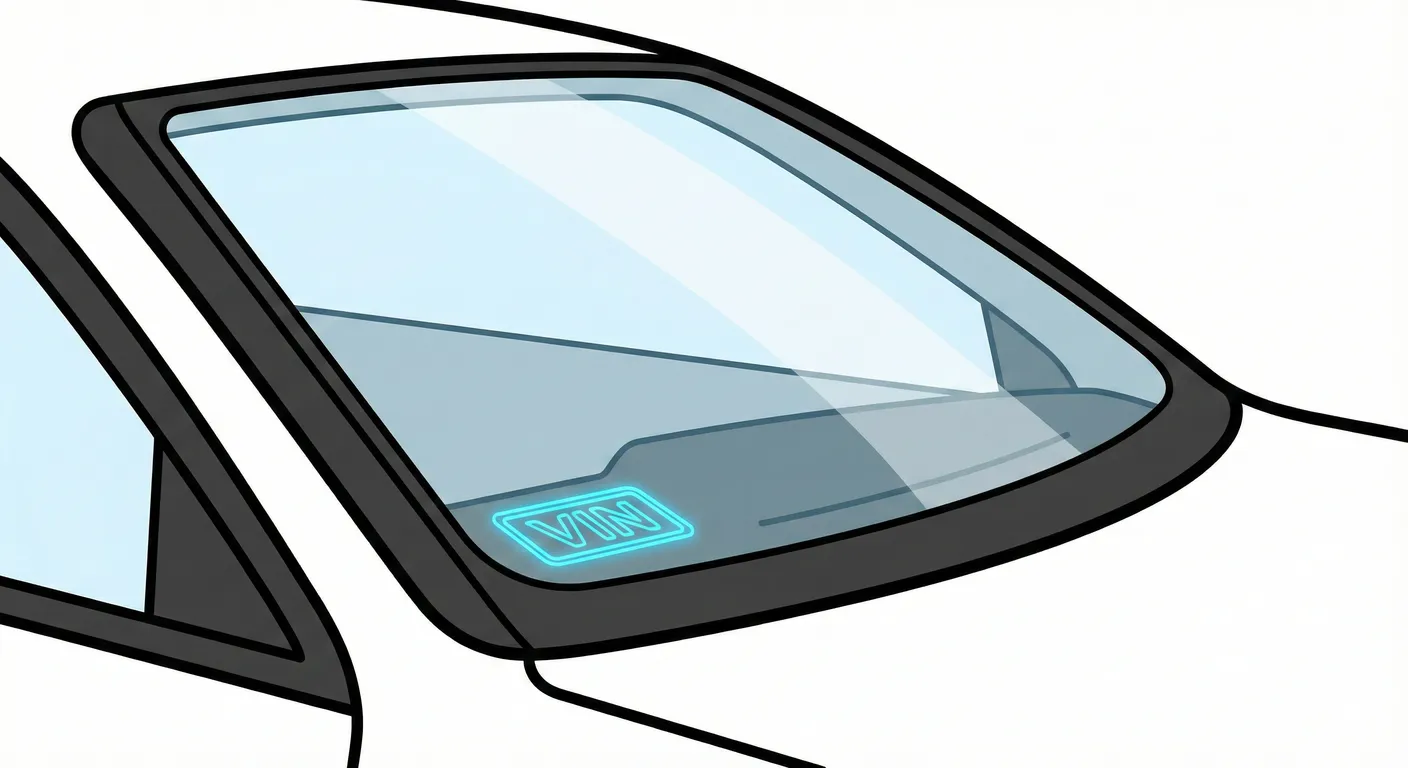
- Where to look: Look through the windshield at the bottom corner on the passenger side for the visible VIN tag under the glass.
- Access: Easy to spot, but reflections/glare can make it hard to read or photograph.
- Note: Great for a quick verification without opening doors.
- Tip: If glare is washing out the digits, capture it with your phone using ScanVin.app to avoid transcription mistakes caused by reflections.
Engine block number / engine VIN stamp 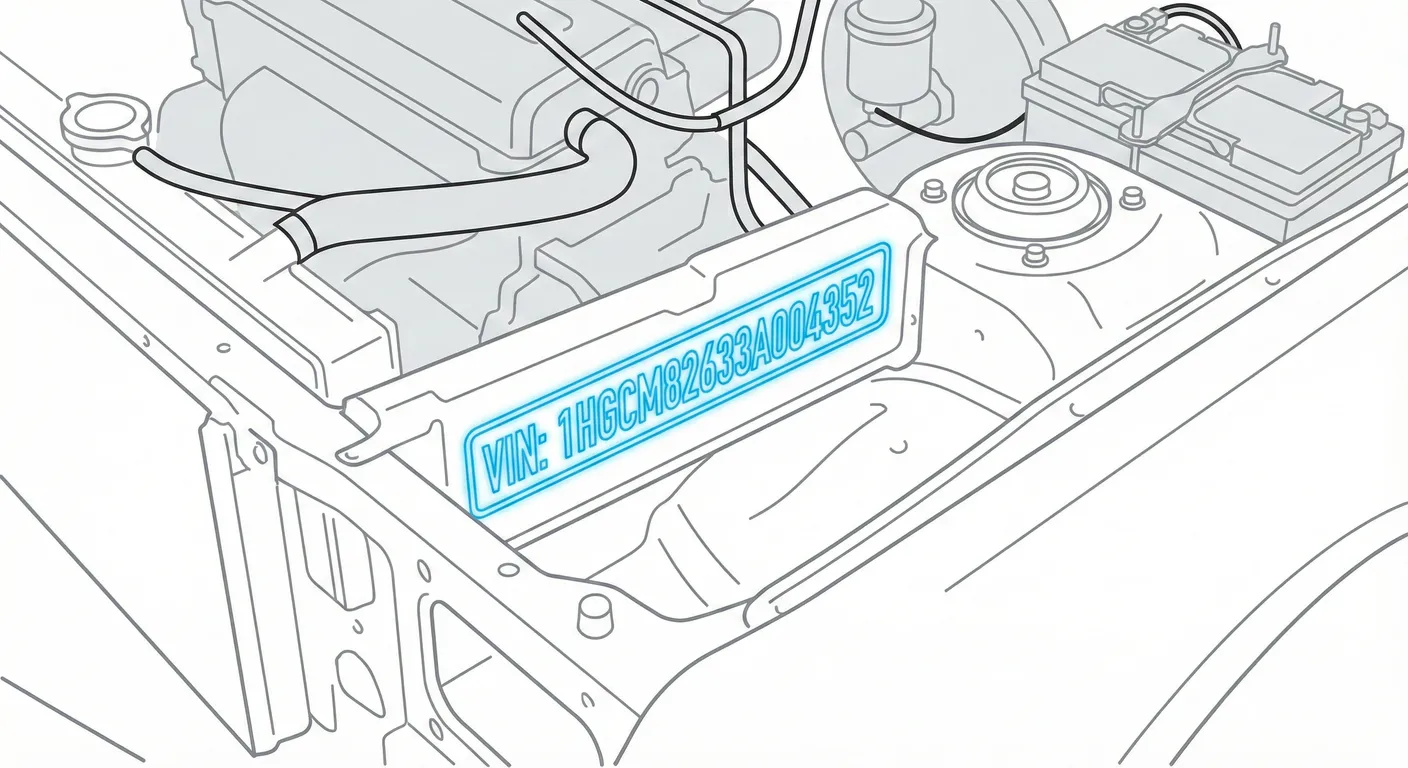
- Where to look: Open the hood. Look deep down between the radiator fan area and the engine, slightly right of center (when facing the engine). The number is dot-peened onto a flat machined surface on the front face of the engine block, near hoses/sensor housings.
- Access: Very difficult—tight space, low light, and often blocked by hoses and wiring. The dot-peen marking can be low-contrast and oily.
- Note: This is the location you check when you need to confirm the engine/block marking, not just the body VIN label.
- Tip: Since it’s deep and greasy, use High Contrast AI Mode to scan it from an awkward angle instead of trying to read dot-peened characters by eye.
Video Guide
Video Tutorial: 2022 renault master van vin and engine number locations
- Clear walkthrough showing the passenger step chassis VIN and an excellent deep zoom on the engine block stamping.
Video Tutorial: Location of chassis number and engine RENAULT/MASTER MBUS L3H2 2013 2014
- All-in-one walkaround confirming the windshield VIN, B-pillar label, floor VIN flap, and a second angle on the engine bay stamp.
Common Problems & Troubleshooting
- Floor stamp is unreadable: Dirt/mud packs into the stamped letters. Scrub with a brush + wipe and use strong side-lighting to make the stamp pop.
- Engine stamp is hard to see: It’s deep, dark, and obstructed by hoses/wiring, and dot-peen text has low contrast—use zoom + high-contrast scanning instead of forcing your head into the bay.
- Sticker vs. stamped VIN mismatch: Door-jamb stickers can be replaced. For identity checks, always compare the sticker VIN to the chassis stamp (and investigate any mismatch before purchase/registration).
Frequently Asked Questions
Where is the VIN on Renault Master?
Start with the chassis VIN stamped under a flap in the front passenger step trim, then check the passenger-side B-pillar/door jamb VIN label.
Which VIN location is the most important for Renault Master?
The stamped chassis VIN (under the passenger step flap) is the most authoritative because it’s physically stamped into the body structure; labels and plates are easier to replace.
Renault Master Master III (Phase II) [2017-2018]
Quick response
Quick Answer: The most reliable VIN location for the Renault Master III (Phase II) is the VIN stamp in the cabin floor at the front door step/stepwell (front footwell area). It’s stamped into the chassis metal under a small trim cover or floor covering. Bring a flashlight—this area is usually shadowed and collects dirt.
This guide shows you where to find the VIN (chassis number) on the Renault Master III (Phase II) produced between 2017–2018, including the most common factory stamp and the easier-to-scan label.
Chassis Number Locations
1) Cabin Floor / Front Door Stepwell VIN Stamp (front footwell)
- Where to look: The VIN is stamped into the chassis metal in the cabin floor at the front door step/stepwell. Look for a rectangular cutout/inspection window in the plastic step trim; some vans have a carpet/insulation flap that you lift to see the stamp.
- Access: Open the front passenger door and pry up/remove the small rectangular cover in the step trim (or lift the floor covering). Expect debris in the recess; wipe/scrub the stamping so the characters pop. This area is typically dark—use a torch.
- Note: For LHD vans this is commonly on the passenger-side front footwell area, but check the driver-side footwell if you don’t find it on the first side (trim and market variations exist).
- Tip: Because the stamp sits in a recessed, shadowed pocket, use the phone flash and OCR to avoid misreading—scan it directly with ScanVin.app instead of guessing characters.
2) B-Pillar / Door Jamb VIN Label (tamper-proof sticker)
- Where to look: Open the front passenger door and check the B-pillar (between the front door and sliding door) or the door edge area—there’s a tamper-proof VIN/vehicle data sticker near the striker/latch zone or on adjacent trim.
- Access: Easy visual check; usually clean and high-contrast. If it’s scuffed from cargo use, wipe it with glass cleaner and a microfiber.
- Note: This label is excellent for quick ID, but the floor/chassis stamp is the one you match against when checking originality.
- Tip: If the sticker text is small, skip manual typing and use the free VIN reader to capture it cleanly in one shot.
3) Windshield / Dashboard VIN Plate (bottom corner)
- Where to look: View through the windshield at the bottom corner on the driver side (outside view looking in). The VIN is displayed behind the glass.
- Access: Clean the outside and inside of the glass; move your body angle to reduce reflections.
- Note: Fastest “walk-up” check, but always confirm it matches the door label and the floor stamp.
- Tip: Reflections and glare cause common transcription mistakes—capture it with your phone using ScanVin.app so you don’t mix up 8/B, 5/S, or 0/O.
4) Engine Bay / Engine–Gearbox Junction (engine number/VIN-related stamping)
- Where to look: Open the hood and look deep in the engine bay at the junction between the engine and gearbox. The marking is on a flat machined surface on the casing (often aluminum), partially hidden behind hoses/ducts/wiring.
- Access: Hard access and poor visibility—expect to use a flashlight and possibly a mirror. Dirt/oxidation reduces contrast, and the angle is awkward for reading.
- Note: The video demonstrates this on an LHD van; on RHD markets you may be working from the opposite side of the vehicle, but the marking remains at the engine/gearbox interface area.
- Tip: When the characters are low-contrast and you’re stuck at a bad angle, use ScanVin.app’s scanning to avoid writing it down manually—it’s faster and reduces errors.
Video Guide
Video Tutorial: Local de número de motor e chassi nova Renault Master 2022
- Walkthrough showing the B-pillar label, the floor/stepwell chassis VIN stamp, and a deep engine-bay search for the engine/gearbox marking.
Common Problems & Troubleshooting
- Floor VIN not visible at first: Dirt collects in the stepwell recess and the stamp sits in shadow—pry the cover, scrub the metal, then use a strong light.
- Engine bay marking “impossible to read”: The surface is deep and partially blocked by hoses/wiring; use a flashlight and clean the area, and don’t expect an easy camera angle.
- Sticker missing or damaged: Door-jamb labels can peel or get scratched on work vans—always verify against the stamped chassis VIN before buying.
Frequently Asked Questions
Where is the VIN on Renault Master?
Check the stamped VIN in the cabin floor at the front door step/stepwell (front footwell area), then confirm it against the B-pillar/door-jamb VIN label.
Which VIN location is the most important for Renault Master?
The stamped chassis VIN in the cabin floor/stepwell is the most authoritative because it is physically stamped into the vehicle structure; use the windshield and door label as quick cross-checks.
Don't see your generation?
Try scanning simple VIN code. Our scanner will automatically identify the Make, Model and Generation.
Scan VINNote on Data Sources
Information about VIN location in this model comes from aggregation of official technical documentation (OEM) and spare parts catalogs. Despite careful algorithmic verification, the data is for reference purposes only. Final vehicle identification should always be confirmed by an authorized technician.
See how we verify data and build our database →