
Where is the VIN in the Volvo V60?
Select your car's generation to see the exact VIN number locations
VIN Location Overview for Volvo V60
2 generationsSelect the generation of your car to see the exact VIN number locations
| Generation & Years | Typical VIN Locations | Details | |
|---|---|---|---|
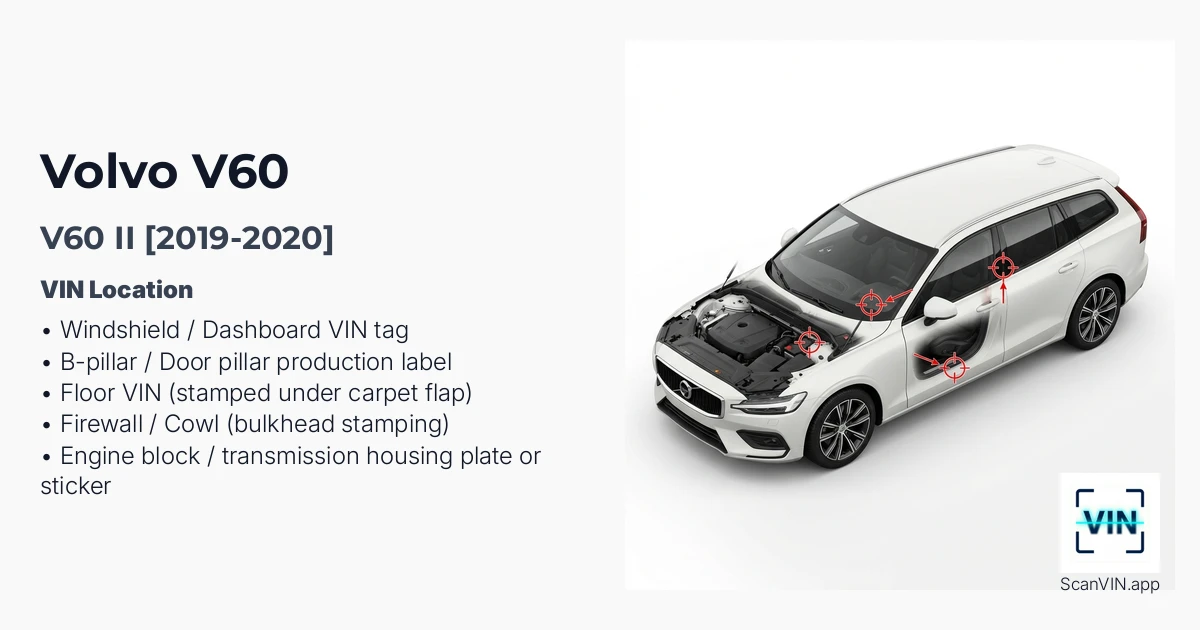 | II 2019 2020 | Windshield / Dashboard VIN tag B-pillar / Door pillar production label Floor VIN (stamped under carpet flap)
+2 | View details |
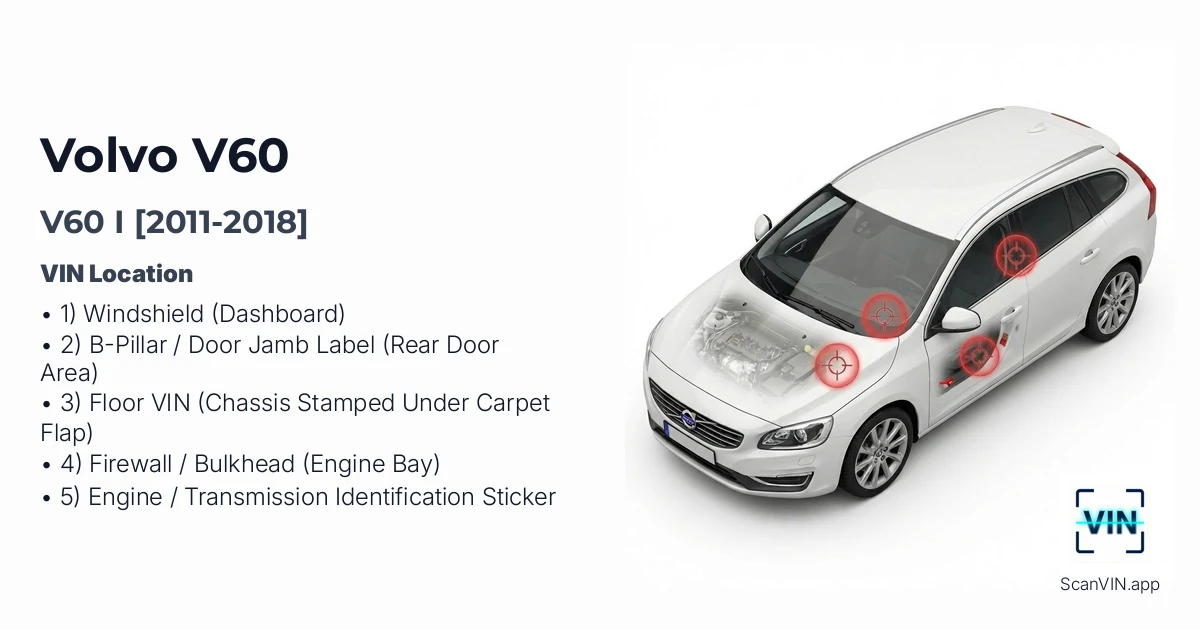 | I 2011 2018 | 1) Windshield (Dashboard) 2) B-Pillar / Door Jamb Label (Rear Door Area) 3) Floor VIN (Chassis Stamped Under Carpet Flap)
+2 | View details |
Volvo V60 V60 II [2019-2020]
Quick response
Quick Answer: The most reliable VIN location for the Volvo V60 is the VIN tag at the lower corner of the windshield (dashboard). It’s typically visible from outside the car at the base of the glass. Expert tip: manage windshield glare/reflections for a clean read.
This guide covers the VIN (Vehicle Identification Number) locations on the Volvo V60 II, produced between 2019–2020, so you can confirm the car’s identity during servicing, registration, or a pre-purchase inspection.
Chassis Number Locations
Windshield / Dashboard VIN tag 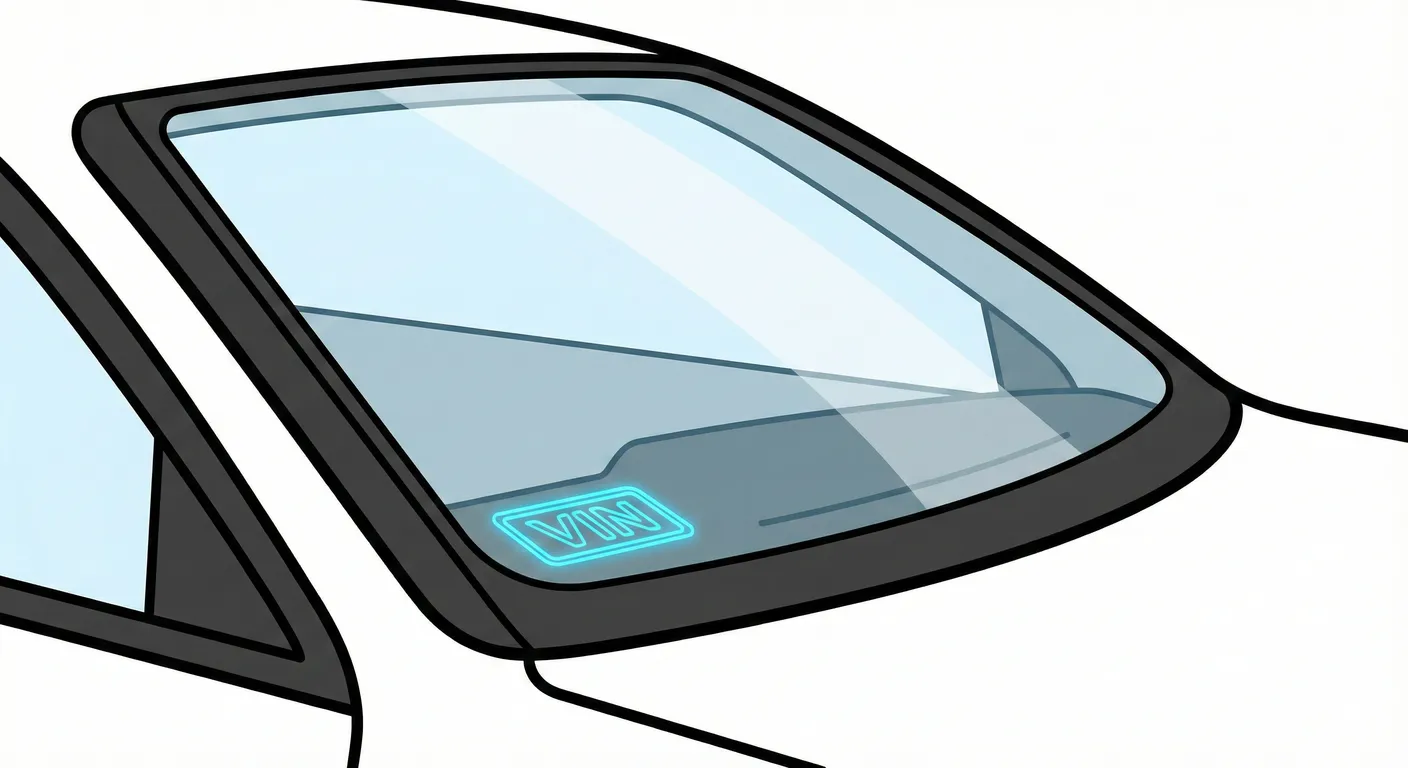
- Where to look: At the bottom corner of the windshield on the passenger side (viewed from outside). It’s a standard visible VIN plate behind the glass at the base of the dash.
- Access: Low to Medium effort. Easy to see, but reflections and glare can make it hard to read or photograph.
- Note: Most LHD (EU/US) cars have this on the passenger-side lower windshield corner.
- Tip: If glare washes out the characters, capture it instantly with the VIN scanner so you don’t misread letters/numbers through the glass.
B-pillar / Door pillar production label 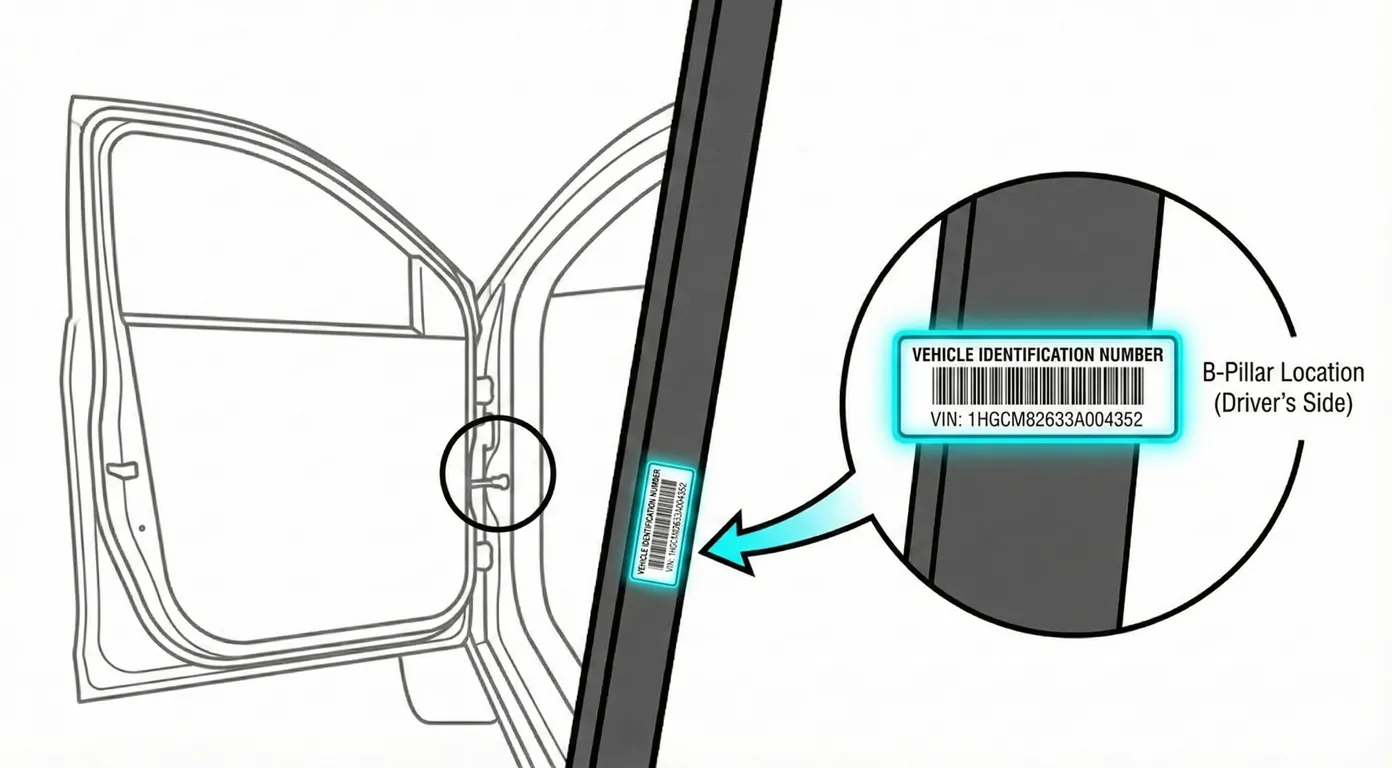
- Where to look: Open the front door and check the door pillar (B-pillar area) for the type approval / production label (a high-contrast black/white sticker).
- Access: Low effort. No tools—just open the door and wipe dust off the label if needed.
- Note: Label placement can vary by market; it’s often on the passenger-side door pillar. On RHD vs LHD cars, the “passenger side” changes, so check both sides if you don’t see it immediately.
- Tip: This label scans cleanly—use the free VIN reader to OCR the code instead of manually typing a long string.
Floor VIN (stamped under carpet flap) 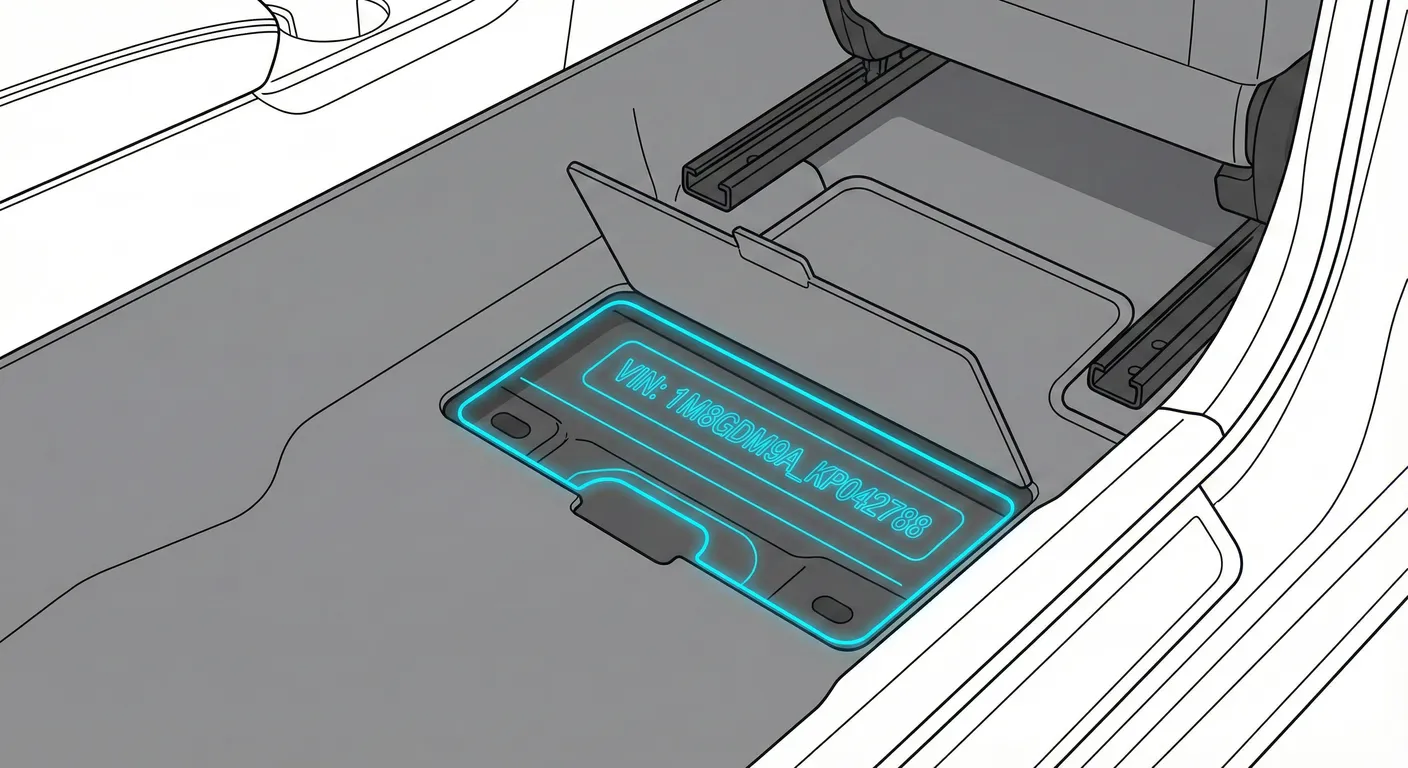
- Where to look: In the front footwell floor under the floor mat, beneath a pre-cut flap in the carpet. Lift the mat, then pull back the cut-out carpet section near the front seat rail area to reveal the stamped chassis number.
- Access: Medium effort. You’ll be prying/lifting trim and carpet; it’s usually dark down there—bring a flashlight.
- Note (LHD/RHD): Check the front footwell floor (commonly on the passenger side for LHD vehicles, but check the driver side footwell if not found).
- Tip: Because it’s shadowy and low to the ground, scan it using Flashlight + OCR to avoid awkward angles and transcription mistakes.
Firewall / Cowl (bulkhead stamping) 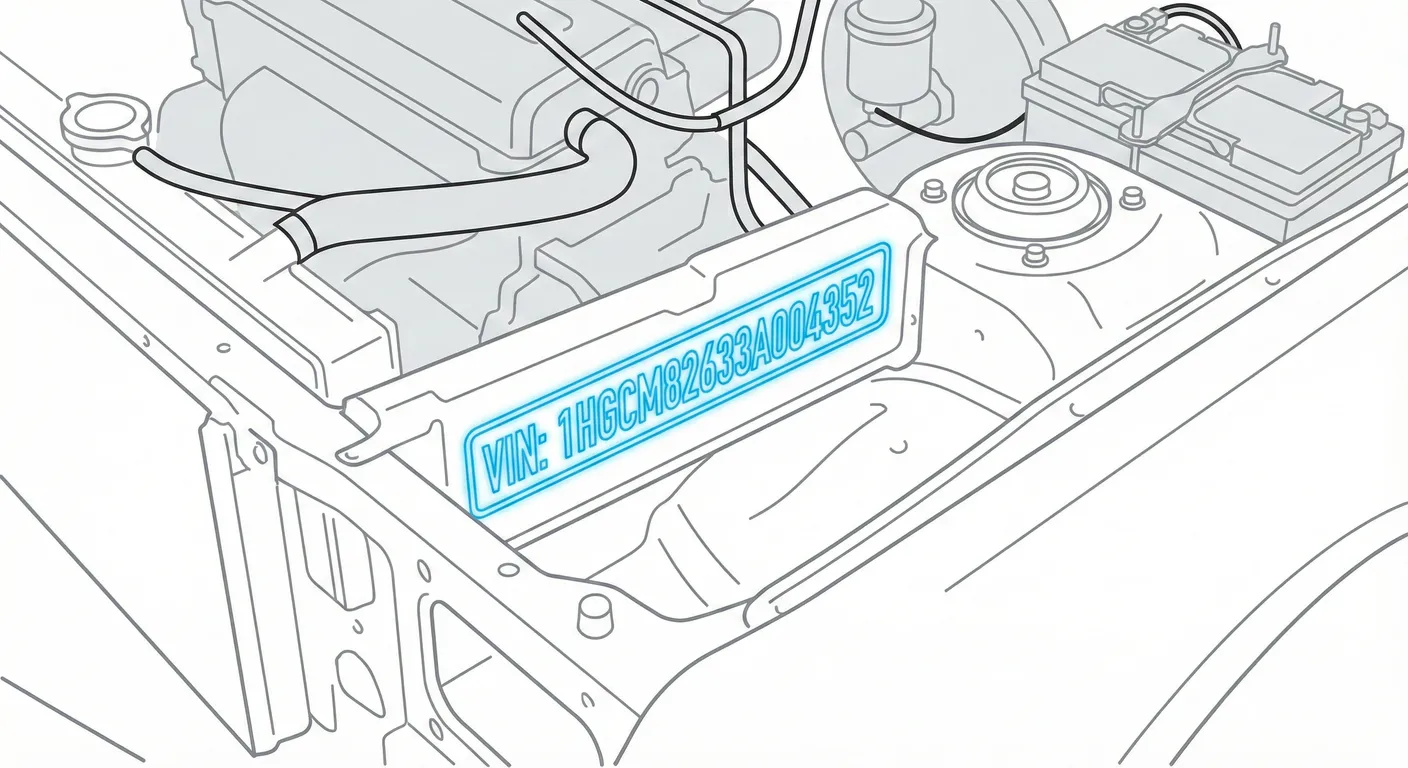
- Where to look: In the engine bay at the rear/top area, on the upper side of the bulkhead/firewall. You may need to look along the cowl line where the engine bay meets the cabin wall.
- Access: Medium effort. The stamping can be partially hidden by plastic cowling or seals—lift them carefully and use a light.
- Note: On some cars this area is easier to read from one side of the engine bay than the other—work slowly and don’t force brittle plastics.
- Tip: If you’re craning over the engine and can’t comfortably write it down, scan the stamping directly to avoid errors.
Engine block / transmission housing plate or sticker
- Where to look: Deep in the engine bay (center/rear area), slightly right of center when facing the car, on a vertical metal plate/sticker attached to the engine block or transmission housing.
- Access: High effort. Tight space, poor lighting, and the surface is often greasy—expect to use a flashlight and possibly degreaser.
- Note: This is more of a “deep verification” number—useful when you need to cross-check identity, but it’s not the fastest place to start.
- Tip: If grime and low contrast make characters hard to read, use High Contrast AI Mode to decipher it instead of guessing smudged digits.
Common Problems & Troubleshooting
- Windshield glare/reflections: Move your body angle, shade the VIN area with your hand, and clean the glass inside/outside to reduce reflections.
- Hidden/stamped VINs in dark areas (footwell/firewall): Use a strong flashlight and clean the stamping with a soft brush; dirt in the grooves will “erase” characters.
- Sticker vs. stamped VIN mismatch: Door pillar labels can be replaced—always cross-check at least one stamped VIN location before buying or registering the car.
Frequently Asked Questions
Where is the VIN on Volvo V60?
Start with the VIN tag at the lower corner of the windshield (dashboard). Then check the B-pillar/door pillar production label for a second quick match.
Which VIN location is the most important for Volvo V60?
Use the windshield VIN for quick identification, but always verify at least one stamped VIN (firewall/bulkhead or the floor stamping under the carpet flap if equipped) for tamper-resistant confirmation.
Volvo V60 I [2011-2018]
Quick response
Quick Answer: The most reliable VIN location for the Volvo V60 is the lower corner of the windshield on the driver’s side (dashboard VIN plate). It sits under the glass at the base of the A-pillar. Expect glare/reflections—capture it quickly to avoid misreading characters.
This guide covers where to find the VIN (chassis number) on the Volvo V60 I, produced between 2011 and 2018, including the easiest scan points and the hidden stamped chassis location.
Chassis Number Locations
1) Windshield (Dashboard)
- Where to look: From outside the car, check the lower corner of the windshield on the driver’s side. The VIN plate is embedded in the dash trim under the glass, close to the A-pillar.
- Access: No tools needed, but glare/reflections, rain, or dirty glass can hide the characters—move your angle slightly and wipe the glass if needed.
- Note: Works the same way on LHD and RHD cars (still visible at the lower corner near the driver’s side).
- Tip: If reflections make it hard to read, scan it directly with your phone so you don’t have to manually copy characters off reflective glass.
2) B-Pillar / Door Jamb Label (Rear Door Area)
- Where to look: Open the rear passenger-side door and look on the B-pillar (the pillar between front and rear doors) for a black manufacturer sticker/label with VIN, weights, and paint info.
- Access: Easy access with the door fully open. The text is small and vertically oriented, but lighting is usually decent.
- Note: This is a printed label (not stamped metal), so it’s great for quick verification.
- Tip: Because it’s high-contrast (white text on black), use the free VIN reader to grab the full VIN cleanly without squinting or mixing up letters/numbers.
3) Floor VIN (Chassis Stamped Under Carpet Flap)
- Where to look: Check the front footwell floor for a rectangular pre-cut flap in the carpet near the door sill/cross member. Lift it to reveal the VIN stamped into the metal chassis.
- Access: Slide the front seat back, lift the carpet flap, and aim light straight down. This spot is often dark, and the stamp can be low-contrast (body-colored metal) or packed with dirt.
- Note: On the V60 shown, this stamped VIN is commonly on the right-hand floor area. For LHD cars that’s typically the passenger side—if you don’t find it, check the opposite footwell.
- Tip: Because it’s shadowy and low-contrast, scan it using Flashlight + OCR to capture the stamped characters without fighting the lighting.
4) Firewall / Bulkhead (Engine Bay)
- Where to look: Open the hood and inspect the center of the firewall/bulkhead, near the bottom of the windshield cowl. The VIN can be stamped on the metal shelf and partly hidden by plastic trim.
- Access: Requires hood open; this area is commonly dusty/dirty and not as easy to frame with a phone.
- Note: Often redundant if the windshield VIN is clear, but useful for cross-checking.
- Tip: If grime or faded stamping makes it hard to read, use High Contrast AI Mode to capture it instead of guessing worn characters.
5) Engine / Transmission Identification Sticker
- Where to look: Deep in the engine bay around the engine/transmission mating area, you may find a metallic sticker/plate (more of an ID point than a buyer-friendly VIN check).
- Access: Typically hard to access without special lighting and patience; awkward angle and limited space.
- Note: This is not the first place I’d send an owner—use it only if you’re verifying drivetrain details.
- Tip: When it’s buried and uncomfortable to read, scan it quickly with your phone so you’re not trying to write down characters in a tight spot.
Video Guide
Video Tutorial: Where is the VIN number of my Volvo V60 I ( 2010 – 2018 ) - YouTube
- Clear walkthrough on a clean LHD V60 showing the B-pillar label, the carpet-flap floor stamp, and the windshield VIN plate.
Common Problems & Troubleshooting
- Windshield VIN glare: Reflections from sky/clouds can wash out the digits—change viewing angle, shade the area with your hand, and clean the glass.
- Floor VIN hard to read: The stamped chassis VIN sits in a dark footwell and can be low-contrast or filled with debris—vacuum/scrub lightly and use a flashlight.
- Sticker vs. stamped VIN mismatch: Door-jamb labels can be replaced—always cross-check the windshield VIN and the stamped floor VIN before you trust the number.
Frequently Asked Questions
Where is the VIN on Volvo V60?
Start with the VIN plate at the lower corner of the windshield on the driver’s side, then check the B-pillar/door-jamb manufacturer label on the rear door opening.
Which VIN location is the most important for Volvo V60?
The stamped chassis VIN (under the carpet flap in the front footwell) is the most authoritative for identity checks, while the windshield VIN is the fastest for day-to-day verification.
Don't see your generation?
Try scanning simple VIN code. Our scanner will automatically identify the Make, Model and Generation.
Scan VINNote on Data Sources
Information about VIN location in this model comes from aggregation of official technical documentation (OEM) and spare parts catalogs. Despite careful algorithmic verification, the data is for reference purposes only. Final vehicle identification should always be confirmed by an authorized technician.
See how we verify data and build our database →